Lauren c. Magee’s Major Paper: “Disability, Corruption, and Humanity in The Stormlight Archive”

Paper Write-Up

            My goals for this essay were simply to illustrate the connection between the many historical representations and explanations for disability, their use as justification in dehumanizing disabled people, and how useful a fantasy setting can be in exploring these concepts. Initially I wanted to write the essay on the infantilization present within The Stormlight Archive, and the strong fandom confirmation of that. However, what I’m interested in as a student mostly finds its way back to religion again and again, and so I decided to go with the flaws of the Vorin Church and how they neatly parallel with, say, Catholic exorcisms. The song is the same no matter how you spin it: discrimination comes back to dehumanization, as nearly all of history has shown. The question was how well such a serious topic can hold up in comparison to, well, a fantasy series so complex it has its own Wikipedia site. I think that while the essay itself is certainly stronger in some parts than others, the basic idea still stands. More than ever fictional characters are how people relate to the world, and we increasingly want to see ourselves in them, know ourselves and be known through them. With that comes the pressure on the author to do research, and do it well. There isn’t enough representation for disabled people, and an even smaller subset is actually good representation. Important also is the idea of plurality, for example one autistic person connecting to an autistic character does not mean every autistic person will see their experiences reflected back the same way. That is also what drew me to The Stormlight Archive, as within a huge cast every single major character is mentally and/or physically disabled. That is not to say there are not criticisms that can still be given (see Renarin as the only “corrupted” character while also the only autistic character, or the series’ habit of people regrowing lost limbs) but that it is refreshing to find a good genre book that gives such authentic voices to the people it sets on the page. Another reason to write this essay is my favorite concept that I have learned in Disability and Literature: the realization that you are disabled only in a society where your mode of thinking/sensory input/physical state of being/medical needs/etc. is not catered to. The world we live in does not have to be disabling and painful to any of us. And the first step towards making it better is lifting up the voices of those hurt, inspiring empathy for others—beginning that deep process of humanization wherever possible—and generally connecting to those we might not otherwise. Getting proximate, and one way to do that is to read. The essay itself could, in honesty, be better if it was written in such an ideal society. I have much to learn, as do all of us. It is good to meet people on ground that they’re already familiar with, and for me, and a surprisingly large amount of others in that world, that ground is a constructed space of fantasy. So be it.   

“I hereby declare upon my word of honor that I have neither given nor received unauthorized help on this word.” -Lauren C. Magee

Total paper word count: 1751 words

Total write-up word count: 518 words

-Paper Contents:-

Lauren C. Magee

Professor Foss

Disability and Literature Major Paper

Disability, Corruption, and Humanity in The Stormlight Archive

            While contemporary works of fiction have undoubtably improved their representation of disability, characters who possess visible physical or mental afflictions are still unfortunately few and far between. If they are represented, the depiction tends to lean towards the stereotypical and even offensive. Representation becomes increasingly offensive the further back in literary canon one goes, human understanding of disabled bodies often explained and condemned by concepts of religion and sin. These were tools to further other and displace disabled individuals and populations, demeaning their basic humanity. By this function, society itself was and is disabling. However, some contemporary works of fiction have sought to explore disability in the above ways through the lens of a fictional society. In Brandon Sanderson’s The Stormlight Archive, the character of Renarin illustrates the concept of dehumanization through the societal outcasting of a disabled individual. The Stormlight Archive offers a unique perspective to mental illness, having the magical abilities of its characters intrinsically tied to their own trauma and neurodiversity, and yet condemned by the religious aspect of their world. Renarin, a character otherwise privileged by the social station of prince, is instead barred from every path of life by the combination of his disabilities.

            The Stormlight Archive is centered around the society of the Alethi, which like our own world has a baseline of strict gender roles and expectations. These expectations are even more strict for the elite classes. Men are given the areas of military, leadership, and retaining a patriarchal line; women are given all branches of the arts and sciences; and the fictional clergy, ardents, can exist outside these boundaries in a sort of gender-neutral space, providing they devote themselves to the Vorin Church’s principles. Any deviation from these roles is met with genuine confusion, for example, the discussion of men learning how to read is seen as unnatural. In fact, unnatural, unholy, and unnerving is the connecting theme for any persons that cannot fit into such a rigid society, especially one taught to be in constant fear of the reassurance of demons—the end of the world. Renarin as a man cannot enter any field of the engineering he shows interest in as he is not a woman, but he is barred from the traditional masculine path of fighting because of his condition of epilepsy. The social skills he lacks from being autistic further alienate him from the societal ideal of a man. Other characters comment on how “[he] was disturbing,” “creepy and whiny” (Words of Radiance 1206-1207), and at times he displays the physical characteristics of autism such as stimming, “rocking back and forth with a small motion” or otherwise fidgeting with a small metal box (Words of Radiance 562). He is urged by other characters to join the clergy, but continues to refuse, protesting for two important reasons: the inherent emasculating of that action, and his own psychosis.

Within The Stormlight Archive, magic and mental illness correlate directly, and become natural products of each other. In order to have any magical ability a person must be explicitly and literally traumatized, explained as “a broken soul [having] cracks into which something else can be fit” (Words of Radiance Cover). Unlike other characters, Renarin has no dramatic or obvious breaking point within his backstory, and there is no reason given by the text to think otherwise. The only conclusion that can be drawn is that his trauma is a direct result of prolonged exposure to the very society that he lives in. Rosemarie Garland-Thompson asks, “If disability is inherent in the human, how can it at the same time disqualify us from full membership in the human community?” (Garland-Thompson 339). Although every major character shares a common condition of being in some way disabled, Renarin is the most visible target from the youngest age. He is disqualified through othering and outcasting to the point where he experiences psychosis, manifesting in-universe as terrifying visions of the literal end of the world. The subject matter itself is alienating; any inclination towards the prophetic is seen by the Vorin Church as demonic, frightening and corrupted. Renarin is severely disabled not only by the general society around him, but the religious aspect of it reacting to his disability.

            Within our own world psychosis has always been interpreted as sinful. Interpretations of hallucinatory experiences and disorders such as schizophrenia have created a narrative where the “demonic” force explained to be causing the disruption can be cured through holy means, usually exorcism. The belief in demons as a cause of neurodiversity has been studied around the world along with practices such as ritual prayer or belief in possession. One study conducted in Switzerland saw that “prevalence of such practices was significantly related to diagnosis and to church affiliation” (Pfiefer). “Curing” epilepsy is one of the strongest examples of this practice. Louise Jilek-Aall, a researcher of epilepsy in different cultures, states in one study that “an atmosphere of fear, shame and mysticism surrounds epilepsy even in our days in many non‐Western and also in Western cultures” (Jilek-Aall). Institutions such as the Catholic church have preformed exorcisms on epileptic patients, believing them to be infested with demonic spirits. In-world, one of the strongest heretical tenets of the Vorin Church is the “forbidden” claim of seeing visions or prophecy, which ironically is the exact nature of Renarin’s hallucinations (Oathbringer 1121). Further complicating the book’s representation is that by its own standards, Renarin is in fact literally demonic, being the only magical character whose magic is tainted in some way by one of the fictional demons. The exact phrasing used multiple times throughout Oathbringer is “corrupted” (Oathbringer 1132). Despite this apparent sin, he shows no changes in overall personality, continuing to be a thoroughly moral character. However, the ramifications of others finding out are so severe that his cousin attempts to murder him near the end of Oathbringer, her reasoning being that Renarin is a “threat” and that “she had to do what was right.” (Oathbringer 1132). She ultimately fails in the moment before the strike, but not because of a sudden change of tactics. Instead, she sees him for a second as a “trembling child… always misunderstood, laughed at and condemned by people who said similar things about [her] behind her back” (Oathbringer 1132). For a character up until this point totally ruled by cold logic, it is her sudden humanization of Renarin that prevents his murder. Compassion is given when instead of a unfeeling vessel of otherworldly or demonic forces, she sees him as family, saying “I know what you are… you’re my cousin” (Oathbringer 1135).

            Additionally, autism itself has a strong history of being seen as otherworldly or alien. It is a recognizable flaw of humanity that parents have strong expectations for their children, which directly affects their perception and acceptance of that child. Historically this has led to devastating impacts on the disabled community as parents rationalize that an autistic child is not actually their “true” child. Empathy for another correlates directly with how worthy of humanity we view the person in question. With reference to the above description of the society within Stormlight, Renarin clearly cannot preform, or is prohibited from preforming, the correct actions to be seen as productive. This leads to a diminished sense of personal worth not only from Renarin himself but his family members as well. In flashbacks his father refers to him as “the other one, the invalid,” as compared to his brother, who meets every standard for the ideal man in Alethi society (Oathbringer 890). This sense of ill-worth and othering is not a new concept and has roots in mythology, a usual addition in the fantasy genre. William Arbury writes that “descriptions of unusual individuals who were regarded as ‘changelings’ or ‘feral children’ often included characteristics similar to those of persons currently diagnosed with an autistic spectrum disorder” (Albury). In essence, the myth of a changeling child simply states that the given child cannot possibly be truly human, or else they would not act in the way that they do. Albury identifies that the myth spans from folklore fairy creatures to Christian demonic forces “stealing” a child. Furthermore, he states that “at one level the metaphors of changeling, feral child, and extraterrestrial all identify the autistic person as someone whose defining characteristics are non-human” (Albury). This passage alludes that the most notable parts of an autistic person, to a disabling world, are the characteristics that set them apart from the rest of that world. Once again, they are not viewed as human, because to be human is to be “correct.” Multiple times throughout The Stormlight Archive, characters comment only on the surface level of Renarin’s character, the traits that they find odd or disturbing. Even his name disturbs people, as it is linguistic nonsense that means “’Like one who was born onto himself.’” (Oathbringer 515).  For a good portion of Oathbringer, his father forgets that he has a second child, focused on the achievements of his first son. Ironically his brother is the first major character to try to understand Renarin, positively thinking of him as “erratic, but once you got to know him, you realized he wasn’t trying to be esoteric” (Oathbringer 114). Along with the unfortunately literal demonic possession, this paints a picture of stark outcasting. In such a rigid social culture, there is little motivation to try to humanize a person already rendered mostly invisible.

            Displayed is only the smallest sample of the systematic discrimination and othering that abled people have perpetrated against the disabled.  As more contemporary works have been written there has been a natural increase in diversity as more writers are empowered to enter the field. Taking from historical sources and lenses of criticism these novels are pushing the boundaries of our social sphere more than ever before. Fantasy, in the past a rather locked genre for one privileged demographic, is experiencing a reassurance of its own, a new understanding of cultures of disability and mental health. This is a realization that these stories are worth telling and portraying, and portraying well. Aspects of our society from well-meaning parents to entire church organizations continue to discriminate and offer false perspectives on disabled lives. By creating empathy through the context of a different world, it is entirely possible that more readers will understand the disabled community, and the dehumanization that still touches a majority of our modern world.

Works Cited & Referenced

Albury, William R. “From Changelings to Extraterrestrials: Depictions of Autism in Popular Culture – Hektoen International.” Hektoen International, hekint.org/2017/01/30/from-changelings-to-extraterrestrials-depictions-of-autism-in-popular-culture/.

Garland-Thompson, Rosemarie. “The Case for Conserving Disability.” 2012. PDF File.

Irmak, M. Kemal. “Schizophrenia or Possession?” SpringerLink, Springer US, 27 Dec. 2012, link.springer.com/article/10.1007/s10943-012-9673-y.

Jilek‐Aall, Louise. “Morbus Sacer in Africa: Some Religious Aspects of Epilepsy in Traditional Cultures.” Epilepsia, John Wiley & Sons, Ltd (10.1111), 2 Aug. 2005, onlinelibrary.wiley.com/doi/abs/10.1111/j.1528-1157.1999.tb00723.x.

Pfeifer, Samuel. “Belief in Demons and Exorcism in Psychiatric Patients in Switzerland.” British Journal of Medical Psychology, John Wiley & Sons, Ltd (10.1111), 12 July 2011, onlinelibrary.wiley.com/doi/pdf/10.1111/j.2044-8341.1994.tb01794.x.

Sanderson, Brandon. The Way of Kings. New York: Tom Doherty Associates, LLC. 2010. Print.

Sanderson, Brandon. Words of Radiance. New York: Tom Doherty Associates, LLC. 2014. Print.

Sanderson, Brandon. Oathbringer. New York: Tom Doherty Associates, LLC. 2017. Print.
Amiti, Bekah, Dylan, and Kyelin’s Major Project

Major Project

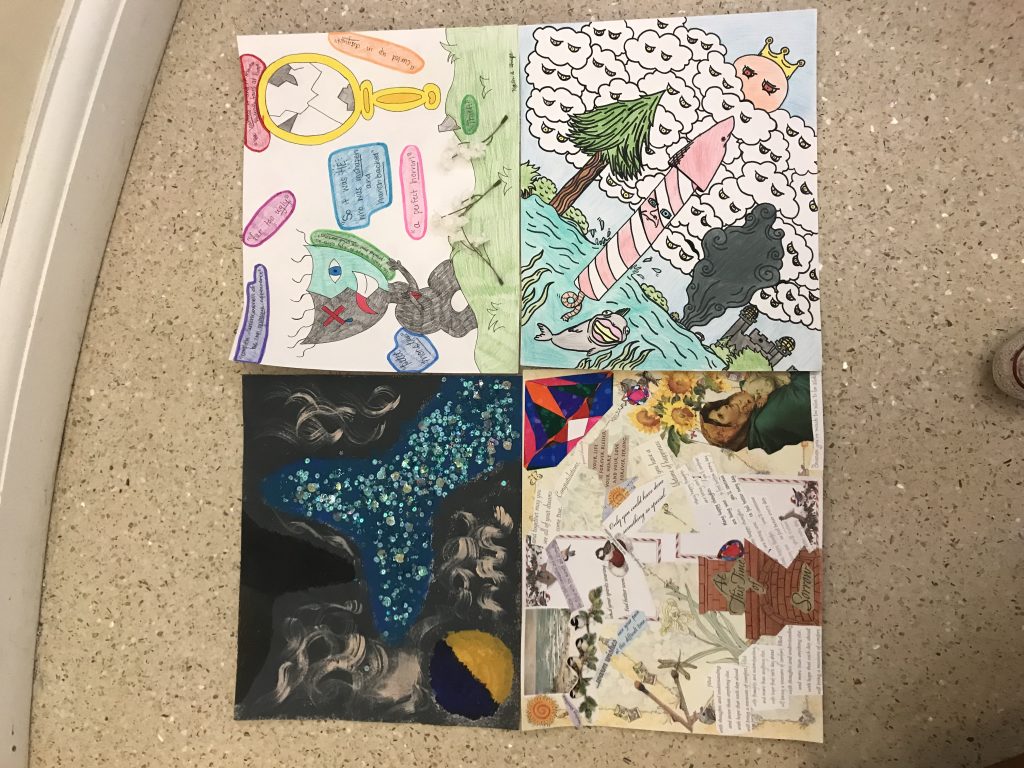
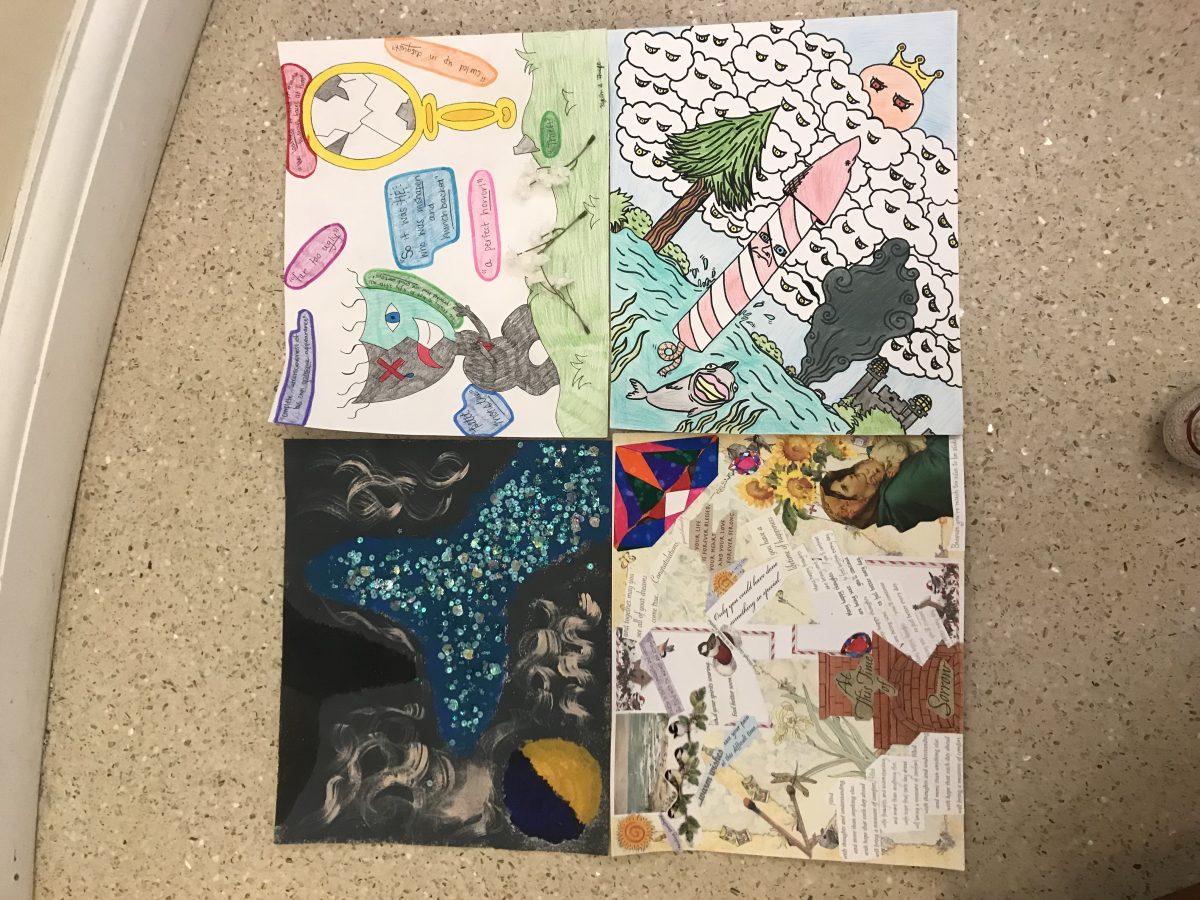
In making this project, we attempted to connect four separate fairy tales by Oscar Wilde–”The Remarkable Rocket,” “The Fisherman and his Soul,” “The Birthday of the Infanta,” and “The Happy Prince,”–to the idea of physical and social barriers in terms of disability. Drawing off of the social model of disability, all four of us oriented our art pieces to physically unite the barriers we found in our respective short stories. Our explanations below of the processes of othering serve as proof of our argument that while these characters may not have been explicitly characterized as disabled or even debilitated in writings prior to the the formation of disabled identity/identities, their representation warrants a conversation on the ways in which we have imagined accessibility in the past in order to better imagine it now.

Dylan Lassiter
For my part, I utilized sketch markers and colored pencils to try and portray “The Remarkable Rocket” in a way that relates back to our main theme of social and physical barriers for disabled persons. The largest physical barrier I address here is also a reimagining of Rocket ending up in the duck pond in the story, rather than the ditch. The pond can be compared to the steps of Rensselaer Polytechnic Institute brought up in Jay Timothy Dolmage’s introduction in Academic Ableism: Disability and Higher Education. The pond I used was to show that the Rocket, with his delusions, was cast out from every sense of community available to him. He didn’t have a rightful place amongst the fireworks that had gone off, he didn’t get along with the animals of the duckpond/ditch, and he didn’t even get recognized as a firework in the end, just a stick. My goal with this piece is to show that the Rocket can easily be seen as a disabled character; inhibited by society and made unable to live how he pleased, thus leading towards his delusion and hard time at life.

Amiti Colson
For my part of the project, I attempted to make a visual representation of Oscar Wilde’s “The Fisherman and His Soul” based on an interpretation of the story in relation to disability studies. The story sets off with a fisherman who accidentally catches a sleeping mermaid in his net while fishing. He makes her promise to return each day to sing for him in exchange for him releasing her back to the sea. Soon, he falls madly in love with the mermaid. Her songs are entrancing and embraces all creatures, she has a very inclusive way of life. The fisherman asks her to marry him and she explains that the only way she can ever be with him is if he sends his soul away. Thus, begins his journey to detach himself from his soul. He seeks the guidance of a priest who has harsh views on the matter. The priest is appalled by the fisherman’s attempt to cast his soul away, stating that “the soul is the noblest part of man.” The priest then explains how the sea-folk are lost because they are soulless, “And as for the Sea-folk, they are lost, and they who would traffic with them are lost also. They are as the beasts of the field that know not good from evil, and for them the Lord has not died.” He goes on to say that the “love of the body is vile” and that the supernatural creatures are “accursed.”
When viewing this in relation to disability studies, one could say that the mermaid and sea-folk represent those who are disabled and othered in society. They are not “normal” beings who walk and live like those who are abled (the fisherman and the priest for example). The priest takes on strong assertions that the sea-folk, because they are different, and in his eyes lacking, they are therefore cursed in their state of mind and body. The fisherman is moved throughout the story by love, by his heart for one of the non-abled beings. The mermaid explains though, that to truly love her, to actually live in her world, he must give up his able-ness, his soul in this manner. He is completely willing to do this for love. The story ends in death and tragedy as all great loves stories do. The fisherman is connected with the mermaid in her death, and the soul is reconnected with the fisherman only in his death. This takes on the perception that abled and disabled love ends in tragedy or conflict, as is seen in media and literature.
For my collage, I tried to show the beauty and light of disability by making the physical barrier a mermaid tale, which is referenced in the story as a way of othering the mermaid from other women because she can not walk on land. I made it bright colors of blue and green and added sequins to make it flashy. I also added a sun and moon, half and half, to show the power balance in the story, between the abled and disabled. For the rest of the collage, I made the background bleak and dark, I made the soul a black shadow of itself. I did this to show that normalcy and the abled world is not always shiny and bright and beautiful. There is a balance.

Kyelin Thrift
For my section of the project, I decided to focus in on Oscar Wilde’s “The Birthday of the Infanta.” My initial goal for this project was to include a mirror that represents the physical barrier displayed in “The Birthday of the Infanta.” I feel that I completed my overall task in my artwork and showed my process in a way that represents the story well. I tried to capture the “ugly” Dwarf’s two opposing moods: the one where he is blissfully ignorant of his appearance and the one where he finally sees his true self in the mirror. His contrasting viewpoints of his life are represented on his face. One side of his face characterizes him before he sees himself where he views the world as beautiful and full of joy, and the other side showcases his extreme sadness when he finds out he is the “monster” all along. When making the Dwarf, I wanted to make the colors stand out just as much as the opposing facial expressions. The black side with the red “X” in place of his eye shows his shattered spirit and his untimely death due to a broken heart. The happy side of his face is represented by bright colors showcasing his upbeat temperament when he thought everyone loved him. I included the broken heart to, again, showcase his broken heart in the short story. The shattered mirror represents his disgust with himself when seeing his “horrid” appearance for the first time. The mirror also symbolizes a well known idiom that basically states “one being so repulsive that their appearance breaks a mirror.” The quotes were added in to show multiple direct lines from the short story that belittle the Dwarf based solely on his outward appearance. The white flowers were more of a last minute decision to include the flowers the Infanta gave him during his dance. I wanted to capture the moment he dropped the flowers to the ground when he shockingly died of a broken heart . The medium I chose to use included pens and colored pencils which would hopefully make my work have a cleaner look.

The mirror is the Dwarf’s physical barrier that shows his own disabilities that are then used to be pitted against him. Since he looks different with his disabled back and legs, the other characters in the story decide to use that as a way to entertain themselves. If different wasn’t seen as so debilitating then the Dwarf probably would not have outright hated his appearance, or atleast to the same extent. When he realized that everyone, especially the Infanta, was laughing at him because of his outward appearance, he then loathed who he was and hated his body. The final result holds significance in that the artwork shows how disabled people are scrutinized over their outward appearance. That most people won’t take the time, especially able-bodied people who just do not understand, to give a differently formed person a chance. The first impression is that these differently abled people are inferior because they are shaped differently. My art shows the less attractive side of human perception when being exposed to diversity.

Rebekah Stone
For my piece of the project, I managed to collage a mix of my own art with get well soon/sympathy cards to represent “The Happy Prince.” My understanding of the story is that class division serves as the largest barrier. Given the real, lived experiences of many, and high correlation of poverty with disability (whether due to the trauma of classism or the expenses of healthcare), it is obviously a really striking tale that can readily be applied as critique of any capitalist system as ableist.
Throughout the collage, I added tear-stained crystals to play on the teardrop shape and the tears of the Happy Prince that kick off the most effective critiques. In the top right corner, I symbolized that barrier of wealth with an image of a tear-stained jewel, similar to the sapphires of the Happy Prince’s eyes. I worked to surround this image with words I felt embraced the irony of his position; “quiet beauty,” “your life is forever blessed, your heart and your love forever strong,” “you have a lifetime of happiness,” etc. He is immobilized–literally disabled by–his own wealth, and the story begins with talk of how happy and fulfilled he must be. For this very reason, I would argue the story wants you to read wealth as a physical barrier; individuals can’t see through it. The aforementioned sayings begin to spread out in two directions–the downward stream, a repetition of the statement “many happy thoughts are being sent, you’ll continue to feel better every day,” serving simultaneously as a reminder that all the happy thoughts directed towards the Happy Prince have changed nothing, and that his thoughts without action have done the same. The words wrap away from the seamstress and her ill son, who are highlighted by the words “much too nice to be sick,” and slowly disappear into the empty fireplace of the young man playwright, which says nothing more than “at this time of sorrow.”
Now in the opposite corner, the following phrase is repeated: “with thoughts and understanding, and more than anything else, with hope that each day ahead will bring a measure of comfort.” This repeated statement–though not terribly different from the last–is meant to convey far more. First and foremost, it speaks to the hopes the Happy Prince had; the future he imagined involved wealth redistribution, even if it left him with literally nothing. Had this hope not existed, there never would have been healthcare for the seamstress’ child; there never would have been sustenance for the creative in debilitating poverty; never would have been a “measure of comfort” for the little match-girl abused by her father. There is another analysis being provided here, though, in the corner opposite where this collage all began; a reed, buried in the background, described in the story as being moneyless and immobilized by firm attachment, is the first love of the sparrow, and stands in stark contrast to the man immobilized by wealth. She is never quoted, though depicted as happy from the outside, just after the same was done of the Happy Prince. The assessment made of her happiness, though, is much different; there is no desire for anyone to be like her. Rather, they find her happiness senseless–her complete lack of wealth makes her equally invisible to society.
Above the washed out matches and the reed, the sparrow’s tale begins to unfold. Combined imagery of birds in winter and birds in summer with the trailing “…warm wishes” “ease your pain at this difficult time,” work to show what disabled–and eventually kills–the swallow (i.e. his continuous delay of departure for Egypt, and the eventual set-in of the cold). Quotes read about the warmth of compassion and the relief of soaring spirits while trailing back to the jewel; the words slowly meshing with the Happy Prince’s descriptors and insisting that “if today were the only day, you would notice” that “only you could have done something so special,” and “we are bonded together through God.” This is meant to indicate the ways in which the couple enable each other to create a more accessible world and, in the process, enter the next.

Conclusion
Whether it be physical barriers like the appearance of the dwarf or the mermaid, or social barriers like lack of community for those who obtain an alternative mindset like the rocket, or the immobilization of the Happy Prince by his own wealth, all of Oscar Wilde’s stories have interconnecting themes of disability. Each story enlightens the reader to new perspectives on disability and how our culture and society shapes those who are othered because of their disability. By making this collage we tethered four of his stories into one overarching image that displays four perspectives on disability in literature.

We all pledge.

Word Count: 2213

Molly Avery’s Major Project

Slam Poetry is often one of the most powerful ways to express emotions. For my major project, I wrote a series of three slam poems from disabled characters points of view. This allowed me to get into the characters head, and try to feel exactly as they felt, so I could get a better understanding of what it is like to live with that particular disability. I wrote way more than I ended up needing, as I ended up writing about 13 pages of poetry. For these three poems I picked The Creation from Frankenstein, Boo Radley from To Kill a Mockingbird, and Shadrack from Sula. I chose to do this project specifically, because I have often turned to writing poetry to help me cope with my mental disabilities. Writing is a beautiful outlet where all emotions can be let go. Nothing is more raw, than a poem.

In “The Creation,” I conveyed The Creations ongoing battle with himself. Within the first few years of his existence he questioned whether he was a monster or not. Of the three poems I wrote, this one was the most challenging. Of all the disabled characters I depicted, The Creation had the highest education, and therefore I feel he would write the most poetic poem of the three. It had the most structure and strictest rhyme scheme. There are 6 stanzas, and 18 lines in each one. This would make for 109 lines in the poem, since they’re actually 19 lines in the first stanza. It follows a rather odd rhyme scheme. It goes: ABBCDDCEECFFGHGHII. Although they are not the same rhymes, the same pattern goes for the rest of the stanzas. The only exception to this is the C rhyme. Throughout the entirety of the poem the C rhyme in all of the stanzas stay the same. This is to show that although all of these events happening in The Creation’s life are occurring at different times, they are all related. Everything that has ever happened to The Creation has shaped him into who he became; a monster. Although that term is up for debate.

In “Boo Radley,” I went over Boo leaving gifts in the tree for the kids, from his view. In this particular poem I broke a little farther out of what the text gave us. I imagined up scenarios between Boo Radley and his family during this time. While writing this text, I focused more on telling a story rather than having poetic elements. Of my poems, this one is the shortest, with just 65 lines. There’s no consistent rhyme scheme or any structure within the poem. This disorganized order has been implemented to showcase the randomness of the gifts Boo gave the children. This was the darkest of all my poems, which seems rather ironic seeing that one was about suicide and the other about murder. We don’t know what happens to Boo Radley behind closed doors, but when your family keeps you locked inside a house, one can assume it isn’t pretty. I touched on issues of self harm and abuse, because I honestly believe that’s what Boo went through.

In “Shadrack,” I covered the thoughts of Shadrack over the course of seven National Suicide Days. I had one stanza for each year. I had originally planned to write all the years covered in the book, but I felt as if by not doing them all, there’s more emphasis on the years that have been written about. For each stanza I focused more on what was happening around Shadrack more than Shadrack himself. I wanted to show that Shadrack was more aware -and just how deeply they affected him- of the happenings of the town than the book let on. This is proven, when he remembers and respects the one visitor he had for a few minutes ,for the rest of his life. I allowed myself to have ten lines in each stanza, and seven stanzas. This adds up to have 70 lines in the poem, but since there is one line standing alone at the end it is actually 71. This is the only poem of my three that doesn’t have any rhyme whatsoever. National Suicide Day was the one day a year that Shadrack accepted utter chaos and disorder. Having rhyme would only take away from this theme.

Word Count: 724

The Creation

Am I a monster?

I was not built to be feared and ridiculed.

There was a time I was desired,

The mere idea of me was admired.

Of having one’s own pet on a chain.

The idea of my existence came from a question,

That quickly grew into an obsession.

That could make any man go insane.

My creator slaved over my body for years,

He persevered through the blood, sweat, and tears.

He gave me life with a heart and a brain.

It never came to his senese,

All the possible consequences.

I awoke to see my God’s utter terror,

Never had I known a face so grim.

And maybe I made my error,

When I smiled at him.

Like a monster.

I am not a monster.

I found solace in the arms of mother nature.

When my God decided to run,

She treated me like her own son.

I weaved through the days in her mane.

I slept on grass and rocks and mud,

And drank from a stream of her blood.

When my stomach groaned in pain.

She pressed me to her chest,

And fed me from her breast.

So much knowledge I had yet to gain.

Her lips looked so red and warm,

They took on no true form.

As all my thoughts were overturned,

I leant in to kiss those lips I adored.

And how it burned!

I ROARED!

Like a monster.

I am not a monster.

There comes a time when the bird must leave the nest.

So I left my mother in search of more,

Wondering what life could have in store.

As the days went on, I began to drain.

With every labored breath,

I began to crave a sudden death.

Anything that would end this reign.

Not too far off there was a small village,

A beacon of hope that I could raid and pillage.

No longer could I keep myself detained.

The night was cold and my feet were sore,

So I began knocking on every door.

Her eyes held so much fear,

That I could not comprehend her plea.

They withdrew their pitchforks and spears,

And banished me.

Like a monster.


I am not a monster.

I trudged through woods unknown to many.

Yearning for a place to rest my head,

I found privacy in an abandoned shed.

My own palace to maintain.

But behind those sturdy walls,

Laid my own set of china dolls.

Their happiness coursed through my veins.

Of all the places I had roamed,

I felt that I had finally found a home.

How much I loved them was insane.

I had to reveal myself, it had been too long,

But I didn’t expect it to go so wrong.

I quickly longed to take it all back,

But the deed had already been done.

When their beautiful bodies cracked,

I had to run.

Like a monster.

I am not a monster.

I sought out my God’s native land.

All I had ever learned was that humans were ruthless,

And I wanted to beat him, ‘til he was toothless.

But upon seeing her, my resentment rested in vain.

I felt myself begin to shiver,

As she drowned in the river.

She looked as if she had made love with the rain.

Her skin was so cold and pale,

A sight to behold for any male.

Such a beautiful situation couldn’t remain.

The man entered the clearing in such a blur,

And concluded that I was going to kill her.

I shouldn’t have been surprised,

But I didn’t even have a chance to flee.

I stood there paralyzed,

And he shot at me.

Like a monster.

I am not a monster.

I had nearly lost all hope of ever finding a companion.

But millions of people walked these lands,

Surely one could see past my beast like hands.

A young boy appeared out of the domain.

Surely he was so pure and uncorrupted,

Like a volcano that hasn’t erupted.

Hanging out of his pocket was a chain.

His eyes met mine with a shriek,

Before my lips even parted for a squeak.

Never had a human caused such pain.

He was the brother of my creator,

Therefore he was the brother of a traitor.

I wished to strangle him until he turned blue,

Tear him apart limb by limb.

Anything to get my point through!

So I killed him.

Like a monster.

I am a monster.

Boo Radley

Jean Louise and Jem Finch were my best friends.

They just didn’t know it.

As reckless as Jem was

Sometimes he was so cautious,

It drove his sister nauseous.

But Scout.

Although she was small,

Her curiosity stood tall.

I knew she would see the treasures.

I left two pieces of gum.

It was a safe start.

I had a whole pack,

But patience was an art.

My father proposed to my mother with a purple velvet box.

Once the ring reached her finger and lips in a kiss,

The box was deserted.

I put that very box in the tree,

Where they would find,

That two pennies were inserted.

They no longer had value to me,

But to them, they would be one of a kind.

I left a ball of twine for them to find next.

I don’t even quite know what they will do with it.

But it was good for fixing

Broken nets,

And broken pants,

And broken men.

I take my time on the next gift.

It’s a soap carving of the two of them.

Before my enslavement, I never knew how to carve.

But when your family is whittling away your heart,

And leaving you to practically starve,

You get a rough idea where to start.

I was so focused on the hair.

I nicked myself more than I would like to admit,

But I didn’t care.

They were worth it.

I knew they had to be missing the gum.

And we had progressed far enough in our exchange,

That I could give them the whole pack,

Without it seeming anything less than strange.

My brother won a spelling medal.

It’s been rusting away in a crate,

He hasn’t touched it since he was eight.

Rather than letting it sit and collect dust,

It would be better in my friend’s trust.

In that very crate the medal lied,

Was my father’s broken pocket watch.

Dangling from it’s chain,

Was the knife I used to trace my veins.

Weeks since I had last opened my arms,

I gave it up, to heal the harm.

Everything had been in such good fun,

Until my brother discovered what I had done.

My brother’s rage knew no bounds,

As he released the hounds.

He gave me front row seating,

To my own personal beating.

He pried my eyes open wide,

And made me watch on in frustration,

As the knot in the tree died,

My only form of communication.

He took that from me.

He took them from me.

He took it all from me.

Shadrack

January 3rd, 1920

Two days after New Years.

When the goals and revolutions,

Were still fresh in their minds.

This was the only way,

The rest of the year could be safe.

With a cowbell in one hand,

And hangman’s rope in the other,

It was National Suicide Day!

Now was the perfect time to die,

Two days after New Years.

January 3rd, 1921

Two days after New Years.

When the memories of Eva’s husband leaving,

Were still fresh in her mind.

She had 3 kids,

2 legs,

1 ex-husband,

And 0 reasons to live.

She didn’t know it, but

Now was the perfect time to die,

Two days after New Years.

January 3rd, 1923

Two days after New Years.

When Chicken Little’s death,

Was still fresh in their minds.

He died three days after,

I had a visitor.

She always left.

She always would.

I had found a friend in this child.

Now was the perfect time to die,

Two days after New Years.

January 3rd, 1924

Two days after New Years.

When the death of Hannah,

Was still fresh in their minds.

The fire in her eyes lingered,

Within the eyes of her daughter.

She burned through her path

From the start,

To the end.

Now was the perfect time to die,

Two Days after New Years.

January 3rd, 1938

Two days after New Years.

When the thought of Sula’s return

Was still fresh in their minds.

My friend was once so small,

She use to fit in the palm of my hand.

But now she had grown.

And we had become one in the same.

She was an outcast, much like me.

Now was the perfect time to die,

Two Days after New Years.

January 3rd, 1942

Two days after New Years.

When the death of Sula,

Was still fresh in their minds.

But this year was different.

This year they opened their shutters,

And came outside.

They danced through the streets,

Down to the tunnel,

Raining of pure cement.

Now was the perfect time to die,

Two days after New Years.

I just wish I died with them.


Carly Rose Hughes’ Major Paper on the Disability Movement as Related to the Civil Rights Movement. [Race] [Identity Politics] [Ableisim]

Carly Rose Hughes; Major Paper/Project Submission
Chris Foss Dis/Lit 384
April 10th 2019
American society runs on a competitive system of power hierarchies, which are seen in race, gender, and abilities. This system depends on society’s “othering” of groups, or the ranking of their value in society by comparing them to the perceived “norm.” This norm—generally a white, heterosexual, able-bodied male—is not only often seen as the most powerful type of person, but the only type of normal person. Any type of person who deviates from this “norm” has their future and their social definition picked out for them. This idea is described in Kafer’s article, “Imagined Futures,” where an ableist society categorizes lesser goals and futures for the disabled author. This ableism is described in Jay Timothy Dolmage’s article, “Academic Ableism,” as a social assumption that able-bodied people are the norm and the most valuable types of people to society. In this way, ableism gives able-bodied people privilege and social benefits that can be compared to white privilege gained through systems of racism. This privilege is described in Robin DiAngelo’s article “What Fragility” as living “without race-based(i.e. oppression based)stress,”.(DiAngelo) Through the Civil Rights movement, black people started to prove their worth to white society, flipping this racist narrative of white dominance to one of black empowerment and value. It is clear that the motivations and effects of ableism and racism are similar, however, the disability movement has not made the same steps of unification or achieved the same general goals as the Civil Rights movement as of yet. However, through their similar experiences, it becomes clear that the Civil Rights movement can be a good model and symbol of hope for the newly-developing Disability Movement through emulation of its unifying first steps which create a more positive social representation of its oppressed group.
Dominant white, heterosexual, able-bodied Americans achieve and maintain their supremacy through oppression and “othering” of groups who deviate from the norm they define themselves as. In this way, biased, oppressive power hierarchies seen in race, gender, and disability are a necessity to the success of the “normal” group in America. For example, Robin DiAngelo, author of “White Fragility,” explains that dominant whites feel threatened by black groups self-advocating against oppression, because this type of discussion challenges the power structures that gave whites the power they hold and therefore their power itself. In fact, DiAngelo says that oppressed peoples are “the backdrop against which white society rises”(DiAngelo). This implies that white people have taken opportunities away from oppressed people such as blacks and given the opportunities to themselves, monopolizing success and profiting off of black people’s suffering. Since this is true, it is clear that if black people were viewed with and given the same respect, opportunities, and status as whites give themselves, then white supremacy would not be a reality because more blacks would be able to achieve success in America. In other words, there is no validity to the racist assumption that whites are more capable and deserving of success than blacks. Black people only live a disadvantaged life because of the disadvantages white supremacists impose on them through segregation, lack of funding of programs, and police brutality. In this way, race is a social construct; difference in value is created only by social assumption.
These racist assumptions and disadvantages impressed upon black people are similar to the effect of ableism upon disabled people, and thus can also be proven a false social construction. Jay Timothy Dolmage defines ableism in his piece titled “‘Academic Ableism” as an assumption that the able-bodied are more deserving of success because they are more capable than the disabled. This ableist bias is seen strongly in author Kafer’s experience as described in his piece, “Imagined Futures.” To society, disability means a life of “relentless pain, isolation, and bitterness”, all qualities that obviously categorize disabled life as lesser than able-bodied life (Kafer 2). However, these qualities are all created by purposefully created ableist disadvantages to the disabled that can be compared to the purposeful disadvantages set up against black people discussed at the end of the last paragraph. Examples of the same types of disadvantages to the disabled can be seen in the staircase described in Dolmage’s “Academic Ableism.” The staircase is both a symbol and a harsh physical reality of the tools used to keep disabled people out of academia, which in America is a key ingredient to success. Dolmage asserts: “Something like the steep stairs outside of a university lecture hall can be critiqued as a spatial and architectural feature that excludes; the stairs can also be understood as making a rhetorical argument or sending a message at the same time”(Dolmage). In this way, the stairs outside a lecture hall are physically inaccessible to disabled bodies, which makes their disadvantage abundantly and specifically clear. Not only are the disabled physically unable to enter the lecture hall, but the stairs and lack of wheelchair equipment and other accessible tools send the message that the university does not even want them to. Additionally, this specific staircase that Dolmage describes can metaphorically stand for the other ways that all types of disabilities are disadvantaged: lack of accessible equipment, lack of helpful accommodations, lack of differentiation in learning styles, and overabundance of expectations like deadlines, time availability, flexibility in types of environments to reduce triggers, etc. In other words, in the same way that racism through segregation, lack of government funding of resources, and police bias precludes blacks from achieving success, it can be seen that the disabled are kept from success not because of their inability, but because of their inability to attain success in a mainstream way that matches the dominant “norm” of society. In this way, it is clear that being disabled is not a tragedy, not an abnormality, but an expected happening in human life.These purposeful disadvantages which are based in factually incorrect assumptions exist then only because white and ableist supremacist oppressors profit from their oppression. The oppression monopolizes the opportunities for success all in favor of the oppressor, and is the only way they achieve their superior status. White Able-bodied control of minority groups is perpetuated by imposing negative identities upon the minorities.
However, the general success of the black Civil Rights movement in the 1960s in fighting these types of disadvantages can give the newly developing disability movement a model of the steps to take to start changing their experience of oppression and bias, because their struggles are so similar and so base level to America’s societal structure. Not only are the disabled and black American experiences similar in the way of the oppression they face, but because of this similar oppression, their movement’s needs are also similar. Both groups needed to forget their differences and unite under a common identity to change the way their group is perceived and represented by society. This idea is backed up by disability scholar Tobin Siebers, who says in their article “Disability in Theory”: “Different bodies require and create new modes of representations. What would it mean for disability studies to take this insight seriously? Could it change body theory..?”(Siebers)
The need for unity and organization can be seen clearly in the divisions and disagreements that exist in the disability movement, showing its new wave, developing status as a movement. Much like how the people of the Civil Rights movement disagreed on religious preferences such as Islam versus Christianity, or political approaches to their issues such as nonviolence versus violence in self defense (All seen in Malcolm X vs. MLK), there are also many divisions and differences in opinion found in the disability movement. For example, “The language surrounding autism, and disability more generally, is itself often a minefield full of argument and opinion. Many claim that the term ‘autistic person’ is demeaning, because it suggests that the individual concerned is somehow defined by their autism, and that this is prejudiced and problematic. For the majority who work in social or healthcare, and in education, the phrase ‘person with autism is preferred”(Murray, “Autism”)Not only are professionals such as the ones mentioned here divided on how to refer to disabled people, but disabled people are divided in how the view themselves: some want to identify in the value and uniqueness of their disability, some want to see themselves as no different from the norm. In some ways, both can be true, because disabled people are only not the “norm” because of how society has defined them. Additionally, it is widely known that there are many different types of disabilities, and not all disability scholars agree on what counts as a disability or even how different disabilities should be dealt with in society, such as transgender issues, mental health, and other sorts of “invisible” disabilities.
As a divided, first wave movement, the disability movement needs to focus on representing themselves under a common positive identity to achieve base line unity. This is supported by author Davis’ assertion in his article, “The End of Identity Politics and the Beginning of Dismodernism,” that “the political and academic movement around disability is at best a first-or second -wave enterprise”(Davis 2). This is because he says “the first wave of any struggle involves the establishment of the identity against the societal definitions that were formed largely by oppression…a pulling together of forces, an agreement to agree for political ends and group solidarity, along with the tacit approval of an agenda for the establishment of basic rights” (Davis 2). These quotes show that a successful movement needs to be unified within itself first, creating a base so that they can take further steps such as creating a well defined common goal. Unity is created by normalizing or “turn(ing) positive” a marginalized group’s identity, since what they all have in common is oppression (Davis 2). The idea that unity is the first step to a successful movement is exemplified in the marginally successful Civil Rights movement, making it a perfect example for the “first wave” disability movement to model off of.
Socially-oppressed black citizens followed these first step ideas found in Davis’ article at the beginning of their movement, making their steps of unity and reinforcement of a positive identity a perfect example for disability. James Baldwin and Malcolm X encouraged their followers to unify under their truthful common identity. The “truth” is that they are all oppressed, but the oppression is unfounded because they are valuable especially because they have overcome the oppression they are subjected to. This type of “identity politics”(Davis) can be seen in Civil Rights leaders James Baldwin and Malcolm X’s assertions that black is beautiful and powerful. To James Baldwin, promoting the feeling that “black is beautiful” means to “rejoice…. Respect… and to be present” (Baldwin) in the value of himself and his life as a black man. He calls for black society to love and appreciate themselves in this way, because this will reject their lower social definition of powerlessness that racist American society has given them by directly juxtaposing it. He demands that black people become “racially conscious”(Baldwin) of their own value and entitlement to fair treatment and status in American society in this way. Racial consciousness means to be aware of the truth—they are not lower in society because they deserve to be, but because they have been systematically oppressed into that position with the methods and tools discussed above. This racial consciousness is the defining point of unification in the Civil Rights movement. It promotes positive identity politics for all blacks no matter what their differences are, as Davis asserts a first wave movement should. In fact, Malcolm X advocates for blacks to forget dividing differences such as religion and class, because no matter what, all blacks are oppressed and should push for respect that a people as beautiful and powerful as they are deserve. This unification and uplifting of the black race was essential to the movement for civil/human rights, because, as Baldwin says, if black people demonstrate their racial consciousness by standing up for themselves in self defense and advocating for their worth, they will “…create, the consciousness of the others…” (whites) “and end the racial nightmare, and achieve our country, and change the history of the world”.(James Baldwin) The knowledge of worth and value that racial consciousness embodies also encompasses the truths previously discussed. Hierarchies in power based on deviation from the perceived “norm” are socially-constructed and have no validity. All in all, this analysis shows that the Civil Rights movement was strategic in its success by taking calculated steps to build throughout their movement, which is even now still progressing against racial bias.
Like the Civil Rights leaders, disability leaders and scholars need to focus on what makes them the same: The stigmas seen in Kafer’s “Imagined Futures,” the lack of respect, lack of feeling of safety, and lack of rights that they all experience, instead of focusing on differences in opinions and approaches that were discussed above. Because of these similarities, disabled activists, leaders, and scholars should focus on changing the negative stereotypes that society defines them by and promote the more positive truth: disability is beautiful, valuable, and worthy of respect in society. This is the truth, because as we saw with Dolmage’s staircase metaphor, if disabled people were given tools such as wheelchair equipment, medications, academic accommodations, and technology to help communicate, they would be able to reach the same success and power that able-bodied people have. By being unified under a common identity, disabled groups can then formulate a common goal. By choosing to act their positive truth through advocacy, confidence, and love of other disabled people, disabled groups could bring a sense of “ability consciousness” to society that parallels the idea of “racial consciousness.”
Being completely conscious of abilities, races, and power hierarchies in America means to know the truth that no group is more able, valuable, or more powerful than another—there is only the oppressed and the oppressor. Through the similarities in racial struggles that were addressed by the Civil Rights movement, it is plain to see that the disabled are wrongly oppressed for the sole purpose of keeping American society running on its system of competitive power that it always has. However, even today Civil Rights struggles and biases prevail specifically because America is so dependant on oppression. This shows that the disability struggle will also be long, but will be most successful with the first step of unity which will change their social perception and representation, just like racial consciousness and sensuality did for the Civil Rights Movement.

Word Count: 2434 words not including Citation page
CITATIONS

Kafer, Alison. “Imagined Futures.” Feminist, Queer, Crip , pp. 1–24.

Dolmage, Jay Timothy. “Introduction : The Approach.” Academic Ableism: Disability and Higher Education .
DiAngelo , Robin. “White Fragility .”

Murray , Stuart. “Autism .” Autism , Routledge , 2012

Baldwin, James, The Fire Next Time. Random House, 1991.

Siebers, Tobin. “Disability In Theory.” From Social Constructionism To the New Realism of The Body, pp. 173–181.

“Malcolm X Speaks .” Malcolm X Speaks , Merit Publishers and Betty Shabazz, 1965.

Lennard Davis, “The End of Identity Politics and the Beginning of Dismodernism: On Disability as an Unstable Category” from Bending over Backwards.

Major Project Workplace and Disability Game: A Riff Off of Dungeons and Dragons Game

Workplace and Disability Game: A Riff Off of Dungeons and Dragons Game

By Amanda Smith & Ben Fancher

Our project is based off of the tabletop-paper-and-dice game “Dungeons and Dragons.” The concept of the game is to roll a number to successfully perform an action that will benefit them to “survive” throughout the campaign (story plot). Characters will have modifiers that will make the rolled number go up or down depending on their skills, physical appearance, mental and social capabilities. To depicted this game into a disability lens, our four characters that will be played will vary in certain abilities, that will be observed through their skills. Our first character is Victor Frankenstein, based off of Mary Shelley’s main character of her novel, Frankenstein. He will depict an straight, white, abled-bodied, wealthy, and education male. Victor is not disabled, and will have a great advantage over all the other characters throughout the game’s campaign. Our next character is Tom Robinson, he is a supporting character in Harper Lee’s novel, To Kill A Mockingbird. Tom represents an uneducated, black-male with a shriveled left arm (from his cotton gin accident). Tom will be disadvantaged against Victor because of his race, education, and disability. Our third character is Arthur “Boo” Radley, also a supporting character in Harper Lee’s novel. Arthur is a white male that is mentally disabled with an assumed diagnosis of autism and agoraphobia. With these, Arthur will be extremely disadvantaged from Victor and Tom with certain skills. The fourth character, is The Mermaid from the Oscar Wilde’s short story, The Fisherman and His Soul. The Mermaid is a foreign female character that does not have legs and cannot walk. The Mermaid in this campaign is heavily disabled character compared to the others character because of her impairments. All our characters will be doing a campaign that will resemble every character going to their first day of work to the same office to complete the same task, their ultimate goal is to get through the day and get money. By creating these disabled characters and this campaign, our goal is for players to realize some characters will be more advantaged than others and will succeed more easily in skills to succeed in the workplace. It is possible for all characters to finish a day at work,  but for some characters the task will come easier. Throughout this semester in Disability in Literature we have learned that the abled-bodied straight, white, educated male from a wealthy family will have far easier time succeeding in the workplace than other characters who might be just as if not capable to do the job. The only thing that is holding them back is their impairments or disabilities.

Campaign Map: Newspaper Office

-Editor in Chief office

-Stairs to front

-Ramp on side

-Individual desks

-Cooperative group (desk of three)

-Conference room

-Bathroom

-Waiting area (three chairs)

Character Sheets

Campaign Outline

  1. All characters arrive to work at DisLit Times, the self-proclaimed newspaper for teens, tweens, and everything in betweens.  
    1. Characters all arrive at 8 a.m. for their first day. DisLit Times recently had a massive set of layoffs and they need new employees
      1. Introduce the players, have them introduce themselves to each other too
    2. The new Editor-in-Chief: Tom Robinson, the kindest and best man in all of Maycomb county. Recently moved to Fredericksburg, VA, with his family for this new job opportunity. Is optimistic.
    3. The new Health Editor: Victor Frankenstein. Victor left his life in Europe after a number of failed scientific experiments which he refuses to talk about. Is prepared to share his wealth of knowledge of the human body and its needs with the readers of DisLit Times
    4. The new Advice Columnist: Arthur Radley. Arthur’s life has been spent observing people and their troubles, so he is extremely prepared for his new job as the anonymous writer of the “Dear Boo…” advice column. He works from home, but, despite his protests, has to come in today for orientation and to sign some papers.
    5. The new Horoscope Writer: The Mermaid (the one from The Fisherman and His Soul). A life spent musing on life and love has turned the mermaid into the perfect horoscope writer. She is unable to work out of the water, however, so the Fisherman built her a mobile tank to enable her to go to the office and work. The Fisherman moves her around in her tank until they are able to devise a way to make the tank self-propelling in a way that doesn’t combine water and electricity in a harmful way.
  2. Characters roll a perception check as they stand at the front of the building
    1. Looking to beat a 5
    2. If characters succeed in the roll, they notice that the only way up to the front door of the building housing the DisLit Times’ small office is a staircase
      1. This is fine for everyone except the mermaid, who must try and see if there is any other way into the building
      2. Mermaid must roll investigation, looking to beat a 10
      3. If successful, the player sees that there is a ramp on the left side of the building, leading up to another entrance.
      4. If unsuccessful, other players can roll for the same check, assuming that they are polite and not, you know, unempathetic monsters.
      5. Mermaid (propelled by the Fisherman) goes to the side entrance and goes up the ramp and goes inside, while the other players go up the stairs to the front entrance
    3. Describe the Office
      1. Once inside the front entrance, Tom, Victor, and Arthur see the receptionist, Becky.
        1. Ask if they wait for the Mermaid
          1. If they don’t, start the interaction with Becky
          2. If yes, then have the Mermaid head to the front with the others
  3. Interaction with Becky begins
    1. Ask if anyone wants to approach the receptionist, who is ignoring the group of them
    2. Whoever wants to approach starts a dialogue with Becky. Becky reacts like a deer in the headlights if anyone except
    3. During the dialogue, have the characters all roll Constitution saving throws to avoid Becky’s offensive comments.
      1. Victor has to beat a 5. If he doesn’t beat it, he gets asked if he’s sick, since Victor is kind of wiry and pale (because, you know, anxiety) but if he beats it he gets asked if he is the new Editor-in-chief. Becky is very respectful and formal with him, but seems almost nervous about having to talk to the others.
      2. Tom rolls, and has to beat an 18 to avoid hearing Becky say “Oh I heard we were hiring a cripple, are you going to be working in the warehouse? The foreman can give you a tour of the warehouse, you don’t really have to come up here that much.” If Tom rolls high enough, Becky simply asks him to introduce himself to her.
      3. The Mermaid rolls and has to beat a 19. If she doesn’t Becky looks confused and asks the fisherman if this is some sort of new art exhibit that he is delivering? If the roll is successful, she simply introduces herself too and expresses concern that the office isn’t really designed to have a tank wheeled around in it.
      4. Arthur has to beat a 17. If unsuccessful, Becky speaks to him, which is bad enough, but also she inquires about his health, saying that he looks so pale. Probably would call him a pencil or something. If he beats a 17, she remembers seeing in one of the papers that the new advice columnist had severe agoraphobia and would most likely not want to do a lot of talking, and says hello.
  4. After this, the characters roll initiative. This decides what order they are shown around the office. The characters’ respective trips through the office are outlined below
    1. Before all this, Becky calls the various people who are showing the characters around the office to the reception desk
    2. Tom
      1. Shown around the office by Becky. She takes him into the bullpen and to the conference room and finally to his office. Once in the office, Becky begins asking probing questions about his injury: “Does it hurt”, “how did it happen” “Can I see it?” (Unless he rolls another +19 constitution saving throw)
    3. Arthur
      1. Shown around by the Style Editor, Gerald. Gerald is pretentious, rude, and judgemental. Unless Arthur beats a 19 saving throw, Gerald will march him through the office and ask Arthur what’s the matter with him, why is he so quiet, he should speak up if he’s a real man, all that nonsense.
    4. Victor
      1. Shown around by Susan, a columnist for the health section. Victor needs to roll a Charisma check and beat Susan’s modifier of 9. If he does, then Susan is absolutely charmed by him and is just so friendly and welcoming. If he doesn’t, then she is just professional.
    5. Mermaid
      1. She is shown around by the Style Editor, Thomas, who sort of doesn’t know what to do with her, since the tank can’t really be pushed around the office completely safely. (character will do various Dexterity checks to see whether or not the tank is able to get through the office without bumping into anything). Thomas is quiet and polite and helps the Mermaid as much as he can. If the Mermaid succeeds on a Charisma persuasion check of 17, Thomas tells her about how, when he was younger, he had braces on his legs to straighten them out, so he knows how hard it is to get around.
    6. After the four characters are shown around, they are given their paperwork to sign. While the characters sign paperwork at their desks (Tom in his office, Victor at an Editor’s desk, The Mermaid and Arthur in the conference room) the have to do Charisma Intimidation checks to see if Susan and Gerald are going to come up and bother them or not. Victor has to beat a 7, everyone else tries to beat a 15.
  5. Once all the paperwork is done, everyone can give it to Becky to send to HR. All of our characters are now free to get to work.

Meghan McDonagh’s Major Paper: Exploring the Portrayal of Disability in Avatar: The Last Airbender

If you asked a child or young adult to describe the typical hero, they might tell you about a person with strong muscles, an unblemished and handsome face, and a charismatic and outgoing personality. Chances are, even an adult would respond this way. The representation of marginalized groups in fiction remains shockingly sparse in modern America, but more and more content creators are striving to portray disabled characters and characters of color. Disability is often brushed aside, misrepresented, or just severely lacking in general. Young adults and children with disabilities must sift and sort through the dismal pile of books and shows about able white kids and settle with what the societal default is. The white, cis, able, male is the default choice in character customizable video games, the basis for thousands of stories, movies, and T.V. shows, as well as positions of power in America. So as a society, how do we create positive content to show young people that being anything other than the default is perfectly okay? We can look at the Fries Test, a guide based on the feminist Bechdel Test, in order to determine if a work positively and constructively features disabled characters. The test was created by Kenny Fries, a poet who primarily writes about his identity as a gay, disabled man.

The questions are as followed:

Does a work have more than one disabled character?

Do the disabled characters have their own narrative purpose other than the education and profit of a non-disabled character?

Is the character’s disability not eradicated either by curing or killing?

When it comes to diversity, one of the works that immediately comes to mind is the 2005 animated television show, Avatar: The Last Airbender. In this paper, I will analyze how Avatar portrays and handles disabled or differently-abled characters in an overall positive and thoughtful way through characterization, use of the Fries Test and Simi Linton’s article, Reassigning Meaning.

  Avatar takes place in a fictional universe where people can be born with the fantastical ability to control or “bend” one of the natural elements of fire, earth, water, or air. As the show progresses, the main protagonist, Aang, meets several characters who propel him or hinder his journey to eventually restore peace to his warring world. Avatar depicts multiple characters with different types of disabilities, both physical and invisible. Avatar is able to pass the Fries Test with flying colors thanks to its cast of incredibly well represented disabled characters.

Toph Beifong is a young blind girl who is first shown in a vision seen by Aang to be his potential earthbending teacher. Toph is treated by her parents in an ableist way, deciding that there is no way Toph can live a normal, functioning life due to her blindness and that she must be hidden and protected from danger. Her father barely allows her to go outside unattended, claiming that she “is blind and tiny and helpless and fragile,” which are all stereotypical ableist views. However, Toph is secretly a very gifted earthbender, and she requires little aid to navigate the world at all. She even sneaks away at night to compete in earthbending competitions to improve her bending. Because of her age and disability, she is often underestimated, but it is actually Toph’s blindness that grants her a deeper understanding of earthbending. The depiction of Toph’s blindness is a very positive and empowering part of her, due to the fact that there is no mention of her or any other character wanting or attempting to cure her. She created her own style of fighting and maneuvering because she has a different type of “sight.” In the episode, The Blind Bandit, Toph explains that she uses her earthbending to sense vibrations underneath her saying she “sees with her feet.” However, this is not the same as seeing with eyes and it is not a cure or cover-up for her disability. Toph still has limitations with her blindness. She is unable to read or write and is she is uncomfortable with being up high, in water, or on loose terrain. In Simi Linton’s Reassigning Meaning, Linton talks about the implication of “overcoming” a disability. The phrase could either mean that the disability no longer limits the individual, or that the disabled individual overcomes society’s expectation of them. Toph never had to “overcome” her blindness. It is established in little ways throughout Avatar that Toph uses her differently-abled body to her advantage, therefore being capable of teaching Aang a unique way to understand earthbending and in time become the most powerful earthbender in the world. The Fries Test also asks if the disabled character is only there to profit an abled one and Avatar passes this as well. Toph is an important character in her own right and she has her own narrative arcs and struggles that are not purely about her disability. For example, Toph is a confrontational and sarcastic individual whose abrasive personality often clashes with the other female member of their team, Katara. The two of them work out their issues by communicating with each other to resolve whatever is going on between them—all that has nothing to do with her disability. Toph’s blindness is a vital part of her identity without making her into a one-dimensional character.

   Toph is not the only disabled character in Avatar. Late in the first season, the main group travels to a temple where they meet an energetic young man in a wheelchair named Teo. Teo is a minor character in the show, but he is introduced in a very refreshing and non-ableist manner. Teo is met with no surprise or pity regarding his paralyzed condition by the other characters. Teo simply exists in the world with his disability without centralizing the narrative around it. There is also no dialogue about being “confined to a wheelchair,” or that Teo “suffers from paralysis,” as Linton also cites in his article to be harmful in creating an association with helplessness and victimization of disabled persons. One of the members of the group simply compliments his wheelchair, normalizing Teo’s condition to possible wheelchair-using children who watch the show. Teo’s father, built him a wheelchair that has gliding capabilities similar to airbending, even though Teo is not a bender of any kind. Although it is fantastical to be able to glide through the air, it is not portrayed to be a cure for his disability or a way or change him as a nondisabled character.

   Avatar also features characters with mental illness or invisible disabilities. Zuko is a young man who grew up under an abusive father, named Ozai. Zuko actually begins the show as an antagonist, whose goal is to capture Aang and “restore his honor,” a task given to him by his father, who holds the highest position of power in his nation. Zuko is obsessed with this goal and would do anything in order to gain respect from him, despite his father’s uncaring cruelty.

Ozai physically scarred Zuko’s face by burning him when he was just thirteen years old, a mark that Zuko thinks of as a constant physical reminder of his own shame. Ozai’s mistreatment of his son caused Zuko to be physical disfigured, as well as experience trauma and depressive tendencies throughout his life. Zuko exhibits these tendencies throughout his interactions with other characters. He frequently lashes out in anger and rejects any emotional help or guidance from his uncle, who cares deeply about him. Although it is a negative stereotype for a mentally ill character to be an antagonist, Zuko undergoes an emotional redemption arc throughout the entire series to heal and better understand himself and his personal mental struggles. Zuko’s emotional arc highlights his struggles with mental illness significantly. In the first two seasons of Avatar, Zuko constantly doubts his own decisions and deals with internal turmoil about his home-life at every turn. It is common for disabled characters to be used to exhibit villainy because of their condition, creating misrepresented connections between disability and violence. However, Zuko defies this idea, and breaks away from his abusive family and seeks to join Aang and his friends in order to help them restore peace to the world, as well as his own personal life. He does aid the able-bodied protagonist, but again, Zuko serves an extremely important narrative purpose outside of simply existing for the main character. Although he works through many of his mental struggles and trauma, they are not erased from his life. His scar is not gone, and his future actions as the successor to the throne are attributed to his life experience. In Zuko’s case, Avatar would pass the Fries Test for its complex, multidimensional approach to disability in media directed towards children and young adults. Tackling the subject of blatant parental abuse is largely uncharted territory for cartoons and television for younger audiences in the like.

Lastly, one of the more controversial portrayals of disability is Azula, the sister of Zuko. Azula is an interesting case in Avatar, as she is an opposite case to Zuko in respect to her relationship with her father. She grew up being viewed a prodigy, much more talented than Zuko, who was rejected by Ozai. Azula can also be discussed as having sadistic and sociopathic tendencies that alter into what can be described as madness. Reassigning Meaning picks apart what can truly be defined as disability, claiming it is about personal choice to identify. An article titled Coming Out Mad, Coming Out Disabled by Elizabeth Brewer discusses the subject of including madness in disability studies. She speaks about the similarities and differences between being labeled as  “mentally ill,” or “mad,” and the implications that come with each. As mentioned earlier, portraying a villain with madness may lead to unhealthy associations and assumptions. Azula exhibits rather sociopathic tendencies, a product of being worshipped as the princess of the Fire Nation throughout her entire life. What she lacked because of this was the presence of genuine friendships and connections to others. She is also a primary antagonist who controls everyone around her by using fear, as she recruits her two “friends” to join her by threatening them. Azula is also shown having trouble relating to other teens her age since she is hyper-aware of her impact on other people. She does not understand how to act in casual settings with people her age as shown in the episode The Beach. This episode plays off most of these situations as comedic. For example, Azula is shown not knowing how to flirt with boys, which revealed a much more awkward aspect compared to how the audience usually sees her, which is cunning and dangerous. Azula represents many negative aspects of media portraying disability. While Zuko learned how to handle his feelings and personal identity, Azula slowly becomes mentally unhinged after the betrayal of her closest two allies. She begins talking to hallucinations and becoming progressively more self-destructive. Her symptoms can be linked to paranoid schizophrenia. She is restrained and thrown in prison for her loyalty to her dictator father and her mental condition. It can be argued that Azula’s madness was a result of her losing control of her life, and she was considered an evil, manipulative character who must be locked up, creating an unhealthy relationship between disability, madness, and general negativity. Using Azula in this way perpetuates that being “crazy,” a word considered derogatory according to Elizabeth Brewer’s article equates to being abnormal and even evil. Despite Azula’s controversial portrayal of disability in Avatar: The Last Airbender, she is an undeniably layered character that would later be expanded upon in comics released after the show finished airing.

Despite the magical, expansive world of Avatar: The Last Airbender, being intended for younger audiences, disability is not treated lightly. Avatar deeply explores facets of disability that are rarely touched on in other young adult and children literature and media such as mental illness and effectively makes use of the format to create interesting, multidimensional characters and situations. Not once are Avatar characters with disability purely characterized through that one trait. The series does not suggest any ableist language unless it is established that doing so is harmful and negative. The Fries Test proposes questions for positively represented disabled characters in which Avatar: The Last Airbender pass easily. Future works of fiction for young adults and children should use Avatar as a model to represent disability in a thoughtful and positive manner.

I pledge:

Word Count: 2081

Works Cited

Dimartino, Michael D and Bryan Konietzko, creators. Avatar: The Last Airbender. Nickelodeon Animation Studios, 2005.

Brewer, Elizabeth. “Coming Out Mad, Coming Out Disabled.” Literatures of Madness: Disability Studies and Mental Health, edited by Elizabeth J Donaldson, PALGRAVE MACMILLAN, 2018, pp. 11–30.

Linton, Simi. “Reassigning Meaning.” Claiming Disability: Knowledge and Identity, NYU Press,1998, pp 8-33.

Major Paper/Project: [Harper Lee][To Kill a Mockingbird] Claudia Woods

Claudia Woods
4.9.19
Dr. Foss
Disability and Literature

Harper Lee’s To Kill a Mockingbird is famously known for making people uncomfortable. Lee tackles societies many failures from an intersectional perspective.  Specifically, Lee explores disability, gender, and race.  Arthur “Boo” Radley,  Tom Robinson, and Mayella Ewell all experience discrimination because of their marginalized identities. Tom Robinson becomes disabled, is wrongfully accused, is tragically killed because he is a Black man; Mayella is sexually and physically abused because she is a woman; and Arthur “Boo” Radley is isolated and ostracized from society because he is disabled. All characters are betrayed by their community.  Additionally, the significance of this novel being told from the perspective of an impressionable 7 year old girl, Scout and her brother, Jem and the emotional and physical mark the injustices they witness, leave on them, is an important aspect of To Kill a Mockingbird. In To Kill a Mockingbird, “Boo” Radley, Tom Robinson, and Mayella Ewell, hold marginalized identities which disable them. Harper is suggesting that those who hold marginalized identities likely are disabled because of the environment they live in and the treatment they receive from others. 
“Boo” Radley is the primary character that came to mind when discussing disability in Dr. Foss’s Disability and Literature course. This may be because Scout presents him as being the most “obviously” disabled. In her perspective, he is a mysterious, non-verbal, disengaging recluse. Jem describes Boo to jem, “Boo was about six-and-a-half feet tall, judging from his tracks; he dined on raw squirrels and any cats he could catch, that’s why his hands were bloodstained—if you ate an animal raw, you could never wash the blood off. There was a long jagged scar that ran across his face; what teeth he had were yellow and rotten; his eyes popped, and he drooled most of the time” (Lee 47).  However, as readers we see little by little, that Boo is actually quite good natured. Throughout the novel, Boo leaves the children little gifts and notes in a tree, he places a blanket over Scout during the fire, he returns Jem’s pants, and at the end of the novel he saves the children from Bob Ewell’s violent attack. Jem recalls “When I went back, they were folded across the fence...like they were expectin' me” (Lee 96).  Although Boo does not engage with society like able bodied people would, he communicates with his friends from afar. It is unclear exactly how Boo is intellectually disabled, but it is possible that he may have Autism Spectrum Disorder as well as other disabilities. Boo clearly feels most comfortable and safe in his own home, away from others. He never leaves his home, except when he can venture out invisibly. It is also implied that Boo was physically and emotionally abused by his father, explaining his fear of other people. Boo may not engage with people in a typical way; however, he nevertheless shows his humanity through his small acts of kindness. Towards the end of the novel, Atticus tells Scout and Jem not to shoot the mockingbirds. “Remember it’s a sin to kill a mockingbird. That was the only time I ever heard Atticus say it was a sin to do something, and I asked Miss Maudie about it. ‘Your father’s right,’ she said. ‘Mockingbirds don’t do one thing but make music for us to enjoy . . . but sing their hearts out for us. That’s why it’s a sin to kill a mockingbird” (126). This line introduces the novel’s title and is a key theme in To Kill a Mockingbird. Boo Radley for example, is an example of a mockingbird in this context. Boo does not (intentionally) harm anyone, rather, he selflessly embraces Scout and Jem when they are ostracized by the rest of the town. Despite being hurt by his own family, Boo still gives unconditional love to the Finch’s, while the rest of the town gives up on them. Boo nevertheless, still manages to do what he is able, when it comes to caring for his friends. I believe this quote applies not only to Boo but to Jem and Scout as well. 

Jem and Scout are both innocent characters, easily impressionable by their surroundings. They grow up in a racist, sexist, ableist town, and manage to maintain their acceptance and openness because of Atticus’s values. Their witnessing of Tom Robinson’s unjust sentence and murder, Mayella’s sexual and physical abuse by her father, Boo’s ostracisation, and their own social rejection and hatred from the town, emotionally and physically scars them. Jem confides in Scout, “If there’s just one kind of folks, why can’t they get along with each other? If they’re all alike, why do they go out of their way to despise each other? Scout, I think I’m beginning to understand something. I think I’m beginning to understand why Boo Radley’s stayed shut up in the house all this time . . . it’s because he wants to stay inside” (Lee 187). Jem changes after seeing the case, he leaves feeling angry, hurt, and let down by the racist values of his town. He also becomes physically disabled when Bob Ewell attacks him out of feeling spite for Atticus. Claudia Johnson states in her article, “The Importance of to Kill a Mockingbird,” “Jem survives the attack but carries a permanent scar, a symbol of the disabling power of hatred and injustice. Scout says that as a result of the attack, ‘Jem’s left arm is slightly shorter than his right.’ In this way, Jem shares a bond with Tom Robinson, for Robinson’s left arm is shorter than his right.” Although, Jem is born and grows up as an able bodied individual, it is the toxic, hateful climate of his own town that gives him this new disabled identity. Nevertheless, the novel ends with Atticus manipulating the death of Bob Ewell in a way that will protect Boo Radley. Jem, of course, agrees even if it means that he will be at fault for Bob Ewell’s death. Atticus consistently teaches the children that doing the right thing always trumps being accepting by others.“The novel suggests that it is a moral imperative to act in accordance with one’s own conscience, even if it means social ostracism” (Jill May). Even after, Jem bears the psychological, emotional, and physical consequences of standing of realizing his own race’s privileges, prejudices, and violently discriminatory acts, he still chooses ostracism and takes responsibility for Boo’s protection, if it means protecting someone less privileged than himself. Possibly one of the most notable aspects of To Kill a Mockingbird is Lee’s portrayal of race.
Harper unapologetically, represents the racism Black people faced in a predominantly White, racist town in the 1930’s, primarily through Tom Robinson’s court case. To Kill a Mockingbird could not be more unfiltered when accounting the unjust atrocities the Black characters experienced; whether it was Alexandria Hancock’s consistent racism towards Calpurnia, the town’s regular use of the N word, or most notably, Tom Robinson’s false rape accusation, conviction, and violent death. “The novel also reflects the reality of racism in segregated towns in the 1930’s. Blacks are commonly referred to as ‘niggers’ and are considered below the law. Many members of the White society feel justified in inflicting their own form of justice on Blacks” (May, Jill). Tom Robinson, a young, Black man, like Jem, came into the world able-bodied and left the world disabled. As a poor, marginalized, child he had no option to survive, except to do dangerous work that left him with a handicap. As was revealed, in the court case by Atticus, his left arm was significantly shorter than his right arm after an accident. “He looked oddly off balance, but it was not from the way he was standing. His left arm was fully twelve inches shorter than his right, and hung dead at his side. It ended in a small shriveled hand, and from as far away as the balcony I could see that it was no use to him” (Lee 248). Tom Robinson got used to this disability and still managed to find work and support his family made In the end it was societies treatment towards him because of the color of his skin that was most disabling to him. Throughout the case, Atticus made it very clear that Tom Robinson did not sexually or physically abuse Mayella Ewell as she claimed. More and more, he proved that there was no physical way that Tom could have assaulted her. There was also no logic to the narrative of her story. It is very strongly revealed that Bob Ewell sexually and physically abused her, not Tom. However, because Tom is a Black man, and Bob Ewell is White, Tom is wrongfully convicted and not Bob. There is a noticeable pattern in To Kill A Mockingbird, the intersecting of various identities plays a critical role in the formation of these characters roles and treatment in society. One interesting example of this intersection of these identities is Mayella Ewell.
Mayella Ewell is a complicated character as she is both the victim and victimizer, the oppressed and the oppressor. As the oldest daughter of nearly a dozen siblings, in the notably poor Ewell family, she is essentially the mother and caregiver in her family. INSERT QUOTE Mayella is isolated from the rest of the town; however, Tom Robinson passes by her “house” every day. Out of loneliness, she begins requesting help of Tom Robinson. Finally, after several interactions, she makes a pass at him. Tom Robinson respectfully, refuses; however, they are caught by Bob Ewell. Bob Ewell reacts by raping and beating his daughter. My interpretation of the situation is that Bob Ewell forces Mayella to accuse Tom Robinson of rape and battering when he sees the two of them together as punishment. I am in no way justifying Mayella’s actions, that she agreed to wrongfully accuse a Black man of rape. I do see; however, that she did not have any power or choice in her relationship with her father. Like Tom she has limited choices, limited pathways that she can take in order to survive. Her survival, her access to food, to housing, to people, rests on her family, specifically her father. In order to maintain her survival and connection to family, she assumes the role of servant. The only way that she could keep that connection, is by acquiescing to the demands of her father, in this case accusing an innocent, Black man of rape. Although, it is made clear throughout the case that Bob Ewell was in fact the abuser, Mayella nor Tom Robinson receive justice, Tom Robinson is convicted and Bob Ewell remains free, which inevitably means Mayella will continue to be raped and battered. Additionally, Mayella cannot seem to understand Atticus’s sensitivity towards her. “Atticus raised his head. ‘Do you want to tell us what happened?’ But she did not hear the compassion in his invitation” (166). Instead, she responds defensively and believes him to have conflicting intentions. This shows just how negatively she is being treated at home. Mayella’s identity as a woman disables her, contrastly, her identity as a White person, empowers her.
Lee did not want to write a novel with typical characters. Instead, Lee writes an honest story that criticizes the status quo of society, revealing how marginalized people experience life in a town that only acknowledges and accepts white, male, able bodied people. Lee goes even further and suggests that the indifferent, hateful values of the town are physically and emotionally disabling to the young generations, reflecting a need that these values need to be changed to create a brighter, more loving future.

Citations

Johnson, Claudia Durst. “The Importance of to Kill a Mockingbird.” Children’s Literature Review, edited by Jelena Krstovic, vol. 169, Gale, 2012. Literature Criticism Online, http://link.galegroup.com/apps/doc/QBWATH243301480/LCO?u=viva_mwc&sid=LCO&xid=7ea711be. Accessed 8 Apr. 2019. Originally published in To Kill a Mockingbird: Threatening Boundaries, Twayne Publishers, 1994, pp. 13-19.

May, Jill. “In Defense of to Kill a Mockingbird.” Children’s Literature Review, edited by Jelena Krstovic, vol. 169, Gale, 2012. Literature Criticism Online, http://link.galegroup.com/apps/doc/OELDZU886764873/LCO?u=viva_mwc&sid=LCO&xid=485f97c0. Accessed 8 Apr. 2019. Originally published in Censored Books: Critical Viewpoints, edited by Nicholas J. Karolides, et al., The Scarecrow Press, Inc., 1993, pp. 476-484.

Lee, Harper. To Kill a Mockingbird. New York :Harper Perennial Modern Classics, 2006.

Word count: 2,081

I pledge. Claudia Woods.

April’s Response to Elizabeth Donaldson’s Psychographics: Graphic Memoirs and Psychiatric Disability

Donaldson addressed the portrayal of madness in comic books. One of the examples that struck out the most to me was the Batman comics’ Joker and Harley Quinn. I think this was a great parallel because these two characters are so popular in our culture. Arkham Asylum was originally Arkham Hospital in the 80’s rendition of Batman. The Hospital looked normal, like any other hospital. However, in the later comics, the hospital developed into a darker portrayal, Arkham Asylum. The Asylum is very gothic and dark; it portrays the madness inside, feeding into the idea that criminals are all insane. Popular culture uses movies/music/art to process thoughts/feelings/events–This is very problematic because the growing stigma of mass shooters coming from backgrounds of mental health issues is thriving from these media representations of mental illness.

Schizophrenia is a misunderstood illness that was often misdiagnosed as Bipolar disorder in the late 1900s. Donaldson enforces the idea of “Nothing about us, without us,” and stressed that media depictions of schizophrenia are often from people without the illness. Which leads to the question—How can you represent something accurately if you do not truly understand this? The answer is simple, profit does not need a “how”. The consequences are dire for people with mental health illness, because they are stuck between two hard options/risks: keeping the illness a secret to avoid stigma but risk being misunderstood for illness-related complications, or be open about their condition in an effort to be more understood and free but risk being misunderstood for every unpleasant action they do/don’t do being intensely judged/analyzed based off of their illness. It’s a gamble.

The problem cannot just be attributed to these bad portrayals in the media though. Media is something people can choose to indulge in and the opinions they form on real-life situations from the show is out of anyone’s control. Changing media and a person’s art will only cause controversy. What could be beneficial is changing the education system. Why is it that only college students are required to take Psychology? You would think only requiring “educated” people to learn psychology would be a bit problematic. Everyone needs to learn to understand their fellow human being. Psychology, Sociology, and the like should all be required in K-12 education. Science and some math really serve no purpose for most people’s long term career paths, especially in blue collar jobs. With the way math is taught, it is only catered to math that is not functional on an everyday/every person basis. With this in mind, wouldn’t it be monumental to introduce social sciences to the public? The average person could learn far more about human behavior and decency from these classes than the gamble of “following someone’s example.”

Education is not accessible to everyone, but pop culture is. When Suicide Squad came out, I was disturbed by how many teenagers were romanticizing Harley Quinn’s relationship with Joker. Ride or die devotion is idealized, even if the partner is abusive, what matters is sticking through the rough spots. The problem is Harley does not stick up for herself and challenge the Joker’s bad treatment in this movie, she ultimately goes along with whatever he says because of her love for him. Having a partner in crime is an equal exchange, not a one-sided relationship of devoted obedience and tolerance of questionable treatment. Joker never attempts to understand Harley; he only cares about her understanding him and forces her to become mad to do so. Once she is devoted, he takes it a step further and presses her to dive into a basin of chemicals to physically mutilate her skin to being pale to prover her loyalty. He does nothing to meet her as an individual separate from him. The Joker manipulates Harley into absolute loyalty for the sole purpose of self-gratification and a more effective tool for his bidding. Everything is a one-sided test of loyalty, ensuring his tool is effective. Despite all of this, popular culture loves this pairing and I can’t help but wonder how this will affect their idea of a good relationship/partner and only romanticize mental health issues being untreated and used as a tool for abuse.

K-12 education needs to be better, so people can be aware of something being wrong/inaccurate because ultimately the stigma has more risk to fueling more problems than people with mental health issues themselves. Media is consumed by all classes and will form stigma about mental health issues if there is no other context/exposure to the topic in a person’s mind. Keeping knowledge to the people that can afford it only deepens the divide between the working class and white collar/educated workers, which only fuels more tension and more problems.

Mental Health and Stigma

Kaitlyn O’Gorman

Dr. Foss

9 April 2019

ENGL 384

Mental Health and Stigma

The five major categories of mental health conditions are anxiety disorders, mood disorders, psychotic disorders, eating disorders and dementia.  While each of these conditions is unique and each carries varying degrees of hardship, one commonality is that all of these conditions are invisible.  Depending on the degree of severity an individual could be battling their condition every day without anyone being the wiser. Other battles are harder, some individuals require more assistance than others and that is fine too.  No matter the condition, be it clinical depression or schizophrenia, the stigma associated with mental health never fails to rear its ugly head. While society is becoming increasingly more comfortable with formerly controversial topics, we have yet to learn how to treat people with mental health conditions like people. This paper will serve as an informative piece to help bring awareness of the true facts about mental illness and how as a community we can help dissolve the mental health stigma, normalize mental health, and as a result eliminate undue stress for those with mental health conditions.

When a person is born with a physical health condition that condition can be seen and is identified.  The affected individual then receives the proper care and treatment. People with physical disabilities such as missing a leg or being paralyzed from the waist down are often seen as warriors, individuals strong enough to live normal lives while having to depend on a prosthetic or wheelchair.  A person born with a mental illness, however, does not show immediate signs and symptoms of their condition. These ailments often lie dormant, undiagnosed, and unseen; therefore the condition is untreated. The afflicted goes through their childhood and teen years coping with what they assume is normal everyday strife.  The symptoms children display if any are rarely seen as serious, more often than not they are written off as a phase. Some individuals grow up with no symptoms at all, and then they are suddenly hit with a major breakdown between the ages of 18 and 24 years old. Not only are these individuals at war with their brains but they are also fighting the stigma with mental health conditions.  People with mental disabilities are rarely seen as brave individuals; their battles are invisible so their strength is not appreciated or romanticized as much as someone with a disability that you can see. These individuals fighting daily invisible battles are written off as too weak to hold a job or friendships, too weak to handle life. In order to not be labeled as weak, many mental health warriors fight their battles alone and in silence, afraid that if they seek out help or treatment they will be associated with this stigma.

As defined by Mayo Clinic, “mental Health conditions – disorders that affect your mood, thinking, and behavior” (Mayo Clinic. 2015).  This includes common health conditions such as clinical depression and anxiety disorders like panic disorder, obsessive-compulsive disorder, post-traumatic stress disorder, and phobias.  Everyone either knows someone or is someone affected by a mental health condition, “nineteen percent of the adult population in the United States experiences some form of mental health condition” (Parekh, Ranna. 2018).  Anxiety disorders being the most common, affecting nearly 40 million adults in the United States alone. Out of that 40 million, only 36.9% of those individuals are being treated for their anxiety disorder. Even though the number of affected individuals is large enough to say that mental illness is common, they are still not held in the same regard as a physical condition.  

In order to become more aware and active in the mental health movement, it is important to begin by realizing the fact that mental health conditions are as common and can as debilitating as physical disabilities.  Due to the fact that mental health conditions are invisible, it is hard for people to understand that these are real conditions that come with daily struggles. In order to break away from this stigma, it is important to understand what stigma is, Graham C.L. Davey wrote an article in 2013 titled “Mental Health and Stigma” to assist in bringing awareness about the issue and how to finally break from these age-old ideologies.  The mental health stigma is created by the view that “symptoms of psychopathology are threatening and uncomfortable, and these attitudes frequently foster stigma and discrimination towards people with mental health problems” (Davey. 2013). It is a known fact that people are generally scared of the things they know the least about. Rather than learning the facts, people chose to avoid and discriminate against those with mental disabilities.

Mental health is difficult for anyone to constantly maintain, a person with a mental disability has it that much harder to maintain, so why create or contribute to stigma or discrimination of mental health conditions?  Everyone is entitled to having a bad day or the occasional bad attitude, but if someone with a known mental health condition displays anything other than a pleasant attitude it is seen as them acting out or having an “episode”.  There are two different types of mental health stigma, social stigma, and perceived stigma or self-stigma. Social stigma is characterized by discriminating behavior towards individuals with mental health conditions. Perceived stigma is the internalized negative belief with the self, this comes about when a person experiencing social stigma begins to believe and in and agree with these negative reactions or associations with mental health conditions.  Both social and perceived stigma has the power to greatly affect a discriminated person’s mood which in tern, can negatively affect treatment outcomes making it nearly impossible to rise above this stigma.

In a modern society that claims to be tolerant and all inclusive, we are still unable to break away from this ancient stigma.  These beliefs likely stem from early theories that those suffering from mental health conditions are suffering due to demonic possession.  We now understand that demonic possession is not the cause of a mental health condition, however even our modern medical model assists in the stigmatization of mental health conditions, “the medical model implies that mental health problems are on a par with physical illnesses and may result from medical or physical dysfunction in some way (when many may not be simply reducible to biological or medical causes)” (Davey. 2013).  This medical model is reinforcing the idea that those with mental health conditions are “different”, and thus should be treated differently. This idea that one person is “normal” and another person is not should never be the standard way to compare two individuals. The reality is that no matter what condition an individual is harboring, they are still a person. No matter what the situation, a person with a mental disability or a physical one, they still expect, and deserve, to be treated like a person.

The first step to breaking away from mental health stigma is becoming more aware of the facts.  In 2000, researcher Arthur Crisp, conducted a survey of over 1700 adults in the United Kingdom to study the stigmatizing attitudes people held for individuals with mental health conditions. Crisp found that most commonly held beliefs were that “(1) people with mental health problems were dangerous – especially those with schizophrenia, alcoholism and drug dependence, (2) people believed that some mental health problems such as eating disorders and substance abuse were self-inflicted, and (3) respondents believed that people with mental health problems were generally hard to talk to” (Crisp, Gelder, Rix, Meltzer et al. 2000).  While mental health conditions may sound intimidating and dangerous, most individuals with mental health conditions are just as likely to be as violent as anyone else. In fact, only three to five percent of violent actions can be linked to an individual’s mental health condition (metalhealth.gov. 2017). Another common misconception is the idea that mental illness is something someone could choose to “snap out of”.  This stems from not only lack of knowledge but also the seeing is believing phenomena.   Another belief is that those with mental health conditions brought it upon themselves. The fact is that there are numerous factors that contribute to mental health problems like biological factors, trauma, and brain chemistry, none of which are avoidable.  Sometimes things just happen, and having a mental health condition should not be the deciding factor for whether or not someone is employable or simply approachable.

The best way to solve a discriminatory issue such as this is to promote awareness and teach the facts early on, to normalize disability from the very start.  If disability studies became part of the standard curriculum in schools, children would grow with a heightened awareness about disability. These children would grow into adults, unphased and unafraid of both mental and physical illnesses.  By integrating disability studies in elementary, middle, and high school curriculum it will normalize disability and help students become more aware of symptoms and warning signs. By having a basic knowledge of the symptoms and warning signs early on will allow children to not only evaluate their own mental health but also be aware and sensitive to their peer’s mental health as well.  When disability is taught as a normal everyday health unit or noted in books during English class, disability will become normal and it will create a platform for the disability movement to grow.  

Mental illnesses do not discriminate, they lie in wait, fester, and show themselves when we are least expecting it.  Mental illnesses are invisible Instead of maintaining ignorance, and judging individuals for having an ailment they have little to no control over; we should be striving for further research, better awareness, and improved overall care.  Those living with a mental illness such as anxiety disorders, mood disorders, psychotic disorders, eating disorders and dementia are not weak individuals, they are silent warriors, they take on a world that pulls each and every one of us down whilst simultaneously battling their illness.  Those suffering from mental illnesses should never have to be ashamed of their condition or too proud to seek help. As a community of people, we should be practicing awareness and sensitivity, not stigma. We should be pushing for our school system to educate students or at the very least put in the effort to educate our children at home about the symptoms and warning signs so that they are able to identify the issue and be helped earlier rather than after the first breakdown. In the past few years, we have come so far as a community to practice better tolerance and sensitivity for all life.  Why not for those with disability?

Word Count: 1778

I Pledge… Kaitlyn O’Gorman

Work Cited

  • Davey, Ph.D, Graham C. L. “Mental Health & Stigma.” Psychology Today, Sussex Publishers, 2013, www.psychologytoday.com/us/blog/why-we-worry/201308/mental-health-stigma.
  • “Facts & Statistics.” Anxiety and Depression Association of America, ADAA, adaa.org/about-adaa/press-room/facts-statistics.
  • “Mental Health Myths and Facts.” Mental Health Myths and Facts | MentalHealth.gov, 2017, www.mentalhealth.gov/basics/mental-health-myths-facts.
  • Parekh, M.D., M.P.H., Ranna. “What Is Mental Illness?” What Is Mental Illness?, 2018, www.psychiatry.org/patients-families/what-is-mental-illness.

css.php