Dylan and Kyelin’s Final Paper

Autism: The Rift Between Parent and Child

Found within Craig Romkema’s “Perspectives” and also Jim Sinclair’s Don’t Mourn For Us, is the problem of an existing gap in understanding or consensus between an autistic child and their parent(s). Through analyzing these two pieces, it can be established that to bridge this lack of understanding between parent and child the first thing that must be done is to formulate some kind of communication that works and also avoid separating the child from their autism. The manner of what medium this communication may be exhibited through and the level of sophistication/understanding that is brought forth due to this communication is irrelevant. The goal in this establishment of understanding, without envisioning an autistic child as not having autism, should help parents to understand their child’s situation more clearly and overall make their relationship stronger.
In Romkema’s “Perspectives” he begins the poem by presenting the explanations for his autistic behavior through the eyes of “experts”,”Eastern Mystics”, “Psychologists”, “Optometrists”, and “Researchers”. This variance of explanations leads readers to conclude that we truly don’t know why exactly people of an autistic nature do the things that they do, whether they fall under any one categorization of autism (verbal, nonverbal, etc.). In presenting the measurements of his physical processes and body, “…measuring my head, the tightness of my muscles, the tracking of my eyes, the dysfunctions of my stomach.”, Romkema exhibits to us implicitly that there is no singular point of explanation for the nature of autism; mankind cannot yet express the etiology of autism. This lack of explanatory signs is one of the main reasons for parents separating their child from it’s autism, when people don’t have an explanation for behavior they would rather detach that behavior from the “reality” of things such as a living, breathing person. Romkema introduces an important point in saying that some of the researchers who were supposedly trying to help him “overcome” his autism were wrong from the beginning in thinking that as a nonverbal autistic, he could not understand a thing they were saying. Not only is this extremely demoralizing to any sort of person but it brings up the almost obvious solution to this gap that parents of autistic children oftentimes miss, communication. “…somehow we would find each other / connect.” is utilized after this to show that without reciprocation from their child, parent’s can feel discouraged and think that possibly their child has a disconnect from them; that their child is unable to relate to them thus viewing the autism as a barrier in the formulation of their relationship. Romkema then turns his role around in this poem establishing himself as a “researcher” rather than being seen as a victim of autism which is implicit in the beginning of the poem. This idea of an autistic as their own researcher for the disorder brings up an idea differing from what is generally done in medical research, since there are no completely proven reasons for how and why an autistic person acts we can learn best from them since they are the ones who perceive the world through an autistic lens. The idea of communication here acts as a catalyst, the establishment of some form of communication between an autistic person and the people around them is what paves way for the conception of self-research. This communication does not only give an autistic person the ability to make themselves heard but it also lets them be seen as a person with their own individual thoughts and feelings. The idea of seeing an autistic person as an individual with their own desires is seen through Romkema’s repetition of, “Watching my fingers, / Doing nothing, / Down in my room.” Since he established that he is fully able to comprehend the world around him, he earned his right as a person to be left alone to do what he pleases without constantly having to put up with studies and people disrespecting him to his face. Finding a form of communication within this poem offers a solution to the problem of parents, or even random people, in the lives of autistics not letting them decide what they wish for themselves.
Don’t Mourn For Us by Jim Sinclair establishes a very clear theme of parents of autistic children not understanding their words and treatment to these differently abled kids. Sinclair opens the short piece by describing parents initial reaction about finding out that their children are autistic by stating it as, “the most traumatic thing that ever happened to them” (Sinclair, 1). Parents of autistic children feel that the greatest tragedy they could have been given is having a child who expresses differently than what they originally expected. In a sense, the parent is selfish in their way of thinking by seeing this child as a detriment to their life solely based on the fact that that their current autistic child did not meet their preconceptions. Sinclair breaks down his short story into three different categories outlining important messages to parents of autistic children.
“Autism is not an appendage,” is Sinclair’s first important message that signifies to parents that they need to expel the notion that their child may someday be “normal” (Sinclair, 1). The child is autistic and will always be autistic, so the exploration of possibly “relieving” the child, but mostly the parents, of the disorder is a waste of time. Unfortunately, trying to wish that the child did not have autism translates as wishing, “the autistic child I have did not exist, and I had a different (non-autistic) child instead” (Sinclair, 1). This leaves these autistic children feeling unworthy and under appreciated for what they have to offer. This mindset in parents of children who have this disorder is a huge setback for positive representation in the autism community and for their autistic child.
The second representational message states, “Autism is not an impenetrable wall,” showing that parents of an autistic child may not connect the same way they expected (Sinclair, 1). Parents were prepared to interact in a certain manner with their new child and did not come to terms with having to communicate in another fashion. “It takes more work to communicate with someone whose native language isn’t the same as yours,” which makes it difficult for some parents to understand (Sinclair, 1). A new form of communication and interaction needs to be established with both parent and child to help create bonds that the autistic child needs and that the parent hopes to institute. This will help mend the bridge from parent to child by introducing an open understanding that each works differently than how originally expected.
Sinclair’s final message reaffirms that, “Autism is not death,” and should not be characterized as such (Sinclair, 1). Parents have this idealized notion that their child should be “perfect” and that somehow this disorder wrecks them of any future they could have possibly held. Parents always feel that they lost a child to autism, but in reality they “lost a child because the child [they] waited for never came into existence” (Sinclair, 1). Parents of children with autism need to comprehend that autism is not a tragedy or the worst thing that could ever happen to the child. Death is the most tragic incident that could happen to the child and autism does not worsen the child, but changes the parents’ label of “normal” and how normal should be described.
When this preconceived notion of what the “normal/perfect” child should is expelled, then children who are labeled with disorders will not be deemed as less. Mending the gap between parents of autism and autistic children themselves can help expand a new, more efficient range of communication. In analyzing the two works, it is made clear that every child reacts differently in any given situation, so a set standard for normal cannot realistically be sanctioned. In turn, parents acceptance of the child’s disorder will increase the bond between the two parties.

We pledge.

Word Count: 1340

Sources:
Sinclair, Jim. “DON’T MOURN FOR US.” Don’t Mourn For Us, www.autreat.com/dont_mourn.html.

Romkema, Craig. “Perspectives” Perspectives
Amiti, Bekah, Dylan, and Kyelin’s Major Project

Major Project

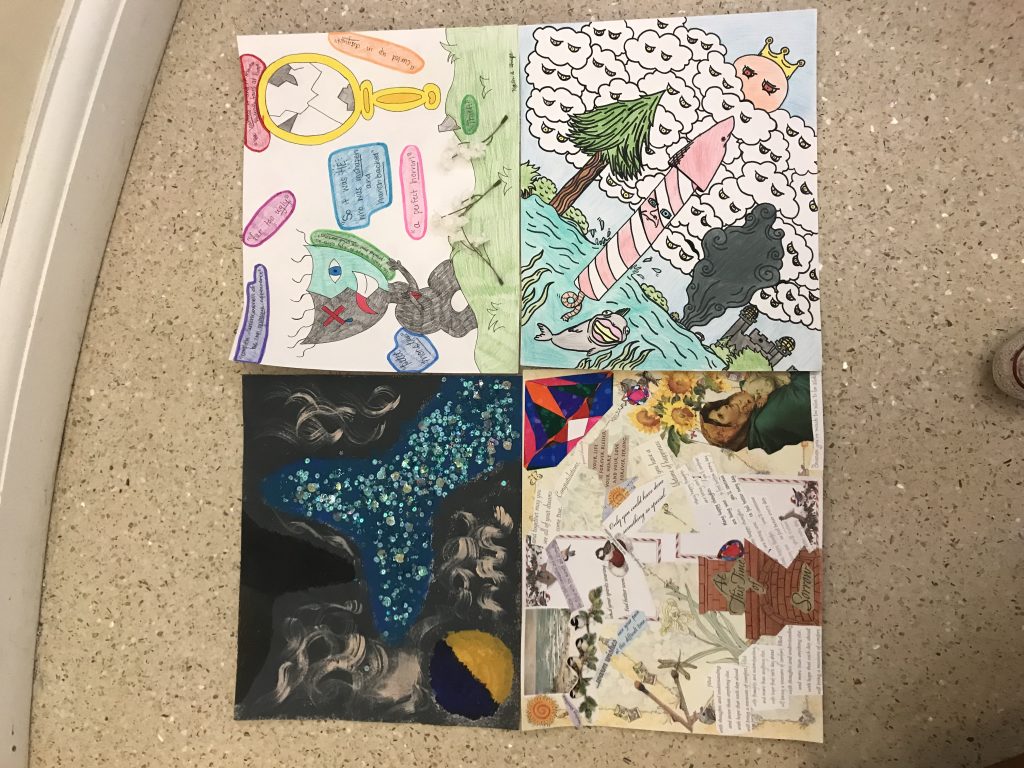
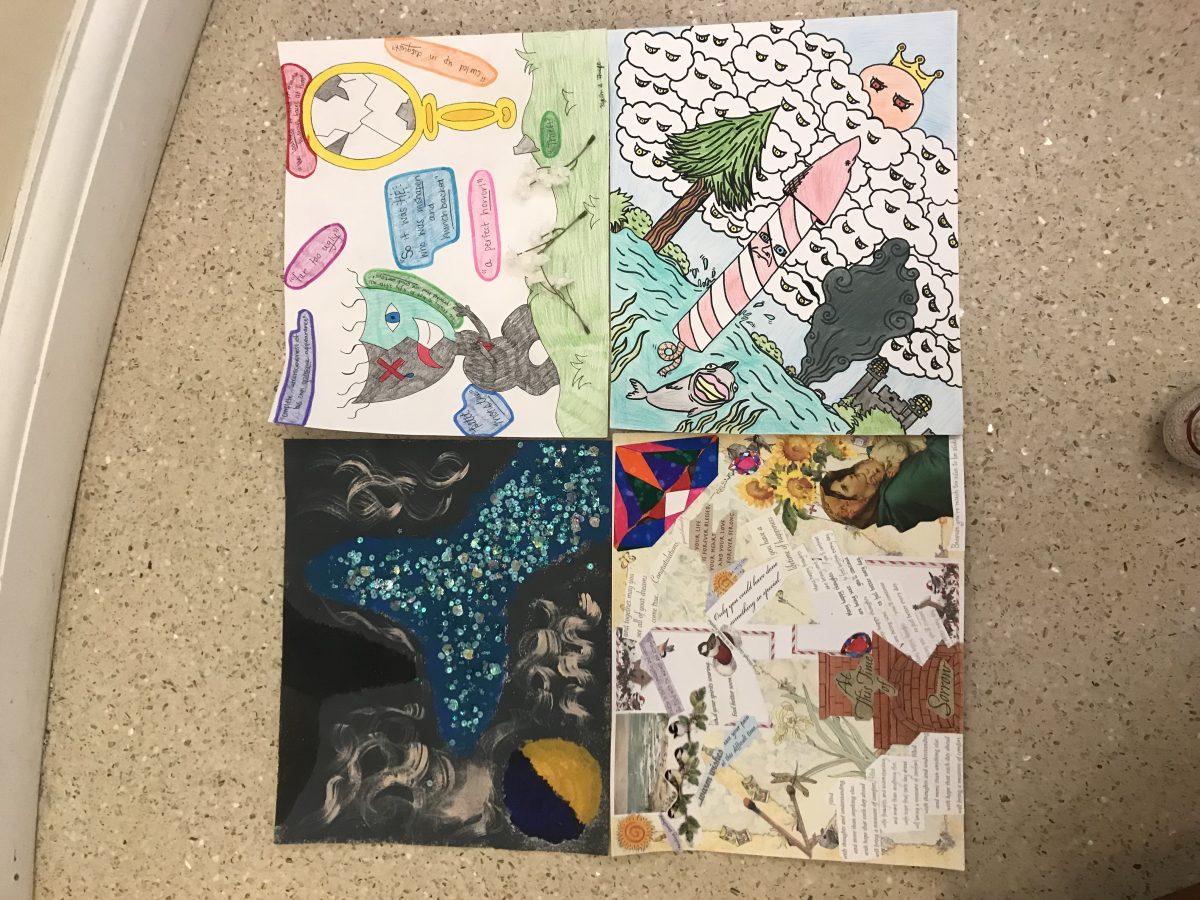
In making this project, we attempted to connect four separate fairy tales by Oscar Wilde–”The Remarkable Rocket,” “The Fisherman and his Soul,” “The Birthday of the Infanta,” and “The Happy Prince,”–to the idea of physical and social barriers in terms of disability. Drawing off of the social model of disability, all four of us oriented our art pieces to physically unite the barriers we found in our respective short stories. Our explanations below of the processes of othering serve as proof of our argument that while these characters may not have been explicitly characterized as disabled or even debilitated in writings prior to the the formation of disabled identity/identities, their representation warrants a conversation on the ways in which we have imagined accessibility in the past in order to better imagine it now.

Dylan Lassiter
For my part, I utilized sketch markers and colored pencils to try and portray “The Remarkable Rocket” in a way that relates back to our main theme of social and physical barriers for disabled persons. The largest physical barrier I address here is also a reimagining of Rocket ending up in the duck pond in the story, rather than the ditch. The pond can be compared to the steps of Rensselaer Polytechnic Institute brought up in Jay Timothy Dolmage’s introduction in Academic Ableism: Disability and Higher Education. The pond I used was to show that the Rocket, with his delusions, was cast out from every sense of community available to him. He didn’t have a rightful place amongst the fireworks that had gone off, he didn’t get along with the animals of the duckpond/ditch, and he didn’t even get recognized as a firework in the end, just a stick. My goal with this piece is to show that the Rocket can easily be seen as a disabled character; inhibited by society and made unable to live how he pleased, thus leading towards his delusion and hard time at life.

Amiti Colson
For my part of the project, I attempted to make a visual representation of Oscar Wilde’s “The Fisherman and His Soul” based on an interpretation of the story in relation to disability studies. The story sets off with a fisherman who accidentally catches a sleeping mermaid in his net while fishing. He makes her promise to return each day to sing for him in exchange for him releasing her back to the sea. Soon, he falls madly in love with the mermaid. Her songs are entrancing and embraces all creatures, she has a very inclusive way of life. The fisherman asks her to marry him and she explains that the only way she can ever be with him is if he sends his soul away. Thus, begins his journey to detach himself from his soul. He seeks the guidance of a priest who has harsh views on the matter. The priest is appalled by the fisherman’s attempt to cast his soul away, stating that “the soul is the noblest part of man.” The priest then explains how the sea-folk are lost because they are soulless, “And as for the Sea-folk, they are lost, and they who would traffic with them are lost also. They are as the beasts of the field that know not good from evil, and for them the Lord has not died.” He goes on to say that the “love of the body is vile” and that the supernatural creatures are “accursed.”
When viewing this in relation to disability studies, one could say that the mermaid and sea-folk represent those who are disabled and othered in society. They are not “normal” beings who walk and live like those who are abled (the fisherman and the priest for example). The priest takes on strong assertions that the sea-folk, because they are different, and in his eyes lacking, they are therefore cursed in their state of mind and body. The fisherman is moved throughout the story by love, by his heart for one of the non-abled beings. The mermaid explains though, that to truly love her, to actually live in her world, he must give up his able-ness, his soul in this manner. He is completely willing to do this for love. The story ends in death and tragedy as all great loves stories do. The fisherman is connected with the mermaid in her death, and the soul is reconnected with the fisherman only in his death. This takes on the perception that abled and disabled love ends in tragedy or conflict, as is seen in media and literature.
For my collage, I tried to show the beauty and light of disability by making the physical barrier a mermaid tale, which is referenced in the story as a way of othering the mermaid from other women because she can not walk on land. I made it bright colors of blue and green and added sequins to make it flashy. I also added a sun and moon, half and half, to show the power balance in the story, between the abled and disabled. For the rest of the collage, I made the background bleak and dark, I made the soul a black shadow of itself. I did this to show that normalcy and the abled world is not always shiny and bright and beautiful. There is a balance.

Kyelin Thrift
For my section of the project, I decided to focus in on Oscar Wilde’s “The Birthday of the Infanta.” My initial goal for this project was to include a mirror that represents the physical barrier displayed in “The Birthday of the Infanta.” I feel that I completed my overall task in my artwork and showed my process in a way that represents the story well. I tried to capture the “ugly” Dwarf’s two opposing moods: the one where he is blissfully ignorant of his appearance and the one where he finally sees his true self in the mirror. His contrasting viewpoints of his life are represented on his face. One side of his face characterizes him before he sees himself where he views the world as beautiful and full of joy, and the other side showcases his extreme sadness when he finds out he is the “monster” all along. When making the Dwarf, I wanted to make the colors stand out just as much as the opposing facial expressions. The black side with the red “X” in place of his eye shows his shattered spirit and his untimely death due to a broken heart. The happy side of his face is represented by bright colors showcasing his upbeat temperament when he thought everyone loved him. I included the broken heart to, again, showcase his broken heart in the short story. The shattered mirror represents his disgust with himself when seeing his “horrid” appearance for the first time. The mirror also symbolizes a well known idiom that basically states “one being so repulsive that their appearance breaks a mirror.” The quotes were added in to show multiple direct lines from the short story that belittle the Dwarf based solely on his outward appearance. The white flowers were more of a last minute decision to include the flowers the Infanta gave him during his dance. I wanted to capture the moment he dropped the flowers to the ground when he shockingly died of a broken heart . The medium I chose to use included pens and colored pencils which would hopefully make my work have a cleaner look.

The mirror is the Dwarf’s physical barrier that shows his own disabilities that are then used to be pitted against him. Since he looks different with his disabled back and legs, the other characters in the story decide to use that as a way to entertain themselves. If different wasn’t seen as so debilitating then the Dwarf probably would not have outright hated his appearance, or atleast to the same extent. When he realized that everyone, especially the Infanta, was laughing at him because of his outward appearance, he then loathed who he was and hated his body. The final result holds significance in that the artwork shows how disabled people are scrutinized over their outward appearance. That most people won’t take the time, especially able-bodied people who just do not understand, to give a differently formed person a chance. The first impression is that these differently abled people are inferior because they are shaped differently. My art shows the less attractive side of human perception when being exposed to diversity.

Rebekah Stone
For my piece of the project, I managed to collage a mix of my own art with get well soon/sympathy cards to represent “The Happy Prince.” My understanding of the story is that class division serves as the largest barrier. Given the real, lived experiences of many, and high correlation of poverty with disability (whether due to the trauma of classism or the expenses of healthcare), it is obviously a really striking tale that can readily be applied as critique of any capitalist system as ableist.
Throughout the collage, I added tear-stained crystals to play on the teardrop shape and the tears of the Happy Prince that kick off the most effective critiques. In the top right corner, I symbolized that barrier of wealth with an image of a tear-stained jewel, similar to the sapphires of the Happy Prince’s eyes. I worked to surround this image with words I felt embraced the irony of his position; “quiet beauty,” “your life is forever blessed, your heart and your love forever strong,” “you have a lifetime of happiness,” etc. He is immobilized–literally disabled by–his own wealth, and the story begins with talk of how happy and fulfilled he must be. For this very reason, I would argue the story wants you to read wealth as a physical barrier; individuals can’t see through it. The aforementioned sayings begin to spread out in two directions–the downward stream, a repetition of the statement “many happy thoughts are being sent, you’ll continue to feel better every day,” serving simultaneously as a reminder that all the happy thoughts directed towards the Happy Prince have changed nothing, and that his thoughts without action have done the same. The words wrap away from the seamstress and her ill son, who are highlighted by the words “much too nice to be sick,” and slowly disappear into the empty fireplace of the young man playwright, which says nothing more than “at this time of sorrow.”
Now in the opposite corner, the following phrase is repeated: “with thoughts and understanding, and more than anything else, with hope that each day ahead will bring a measure of comfort.” This repeated statement–though not terribly different from the last–is meant to convey far more. First and foremost, it speaks to the hopes the Happy Prince had; the future he imagined involved wealth redistribution, even if it left him with literally nothing. Had this hope not existed, there never would have been healthcare for the seamstress’ child; there never would have been sustenance for the creative in debilitating poverty; never would have been a “measure of comfort” for the little match-girl abused by her father. There is another analysis being provided here, though, in the corner opposite where this collage all began; a reed, buried in the background, described in the story as being moneyless and immobilized by firm attachment, is the first love of the sparrow, and stands in stark contrast to the man immobilized by wealth. She is never quoted, though depicted as happy from the outside, just after the same was done of the Happy Prince. The assessment made of her happiness, though, is much different; there is no desire for anyone to be like her. Rather, they find her happiness senseless–her complete lack of wealth makes her equally invisible to society.
Above the washed out matches and the reed, the sparrow’s tale begins to unfold. Combined imagery of birds in winter and birds in summer with the trailing “…warm wishes” “ease your pain at this difficult time,” work to show what disabled–and eventually kills–the swallow (i.e. his continuous delay of departure for Egypt, and the eventual set-in of the cold). Quotes read about the warmth of compassion and the relief of soaring spirits while trailing back to the jewel; the words slowly meshing with the Happy Prince’s descriptors and insisting that “if today were the only day, you would notice” that “only you could have done something so special,” and “we are bonded together through God.” This is meant to indicate the ways in which the couple enable each other to create a more accessible world and, in the process, enter the next.

Conclusion
Whether it be physical barriers like the appearance of the dwarf or the mermaid, or social barriers like lack of community for those who obtain an alternative mindset like the rocket, or the immobilization of the Happy Prince by his own wealth, all of Oscar Wilde’s stories have interconnecting themes of disability. Each story enlightens the reader to new perspectives on disability and how our culture and society shapes those who are othered because of their disability. By making this collage we tethered four of his stories into one overarching image that displays four perspectives on disability in literature.

We all pledge.

Word Count: 2213

Kyelin’s Response to Jonathan Mack”s “The Right Way to be Crippled and Naked”

In Jonathan Mack’s “The Right Way to be Crippled and Naked,” the main character is announcing to his family and friends that he has fully made up his mind to live as a naked Jain monk. He later expresses his reasons in doing so and adds, more than once, that his decision is final and he cannot be convinced otherwise. Mack, a 40 year old queer, disabled man is obviously making his transition to be a Jain monk so that he can finally “let go” (Mack, 49). He describes himself in a self-deprecating way in which he only sees his disability as a setback for himself, so his new revelation to be naked for eternity is a way for him to reclaim his body and his confidence.

Mack discusses, in extreme detail, his days at the gay baths where he would sometimes be selected as a suitable sex partner. This atmosphere in itself is demeaning and only furthered Mack’s self hatred as he saw men not choosing to sleep with him as a direct correlation to his crippled leg. When men did sleep with him, it was only a casual, one-night fling causing Mack to feel just as unfilled as before the encounter. He even states that all his problems would be solved, “if only I were beautiful,” insinuating that all his misfortunes could be corrected with an idealistic “beauty standard” that he wished he could fit (Mack, 47). Jonathan is majorly lacking on self confidence and feels strongly that he needs to overcompensate for his “hairy stick leg… knotted and clawed hoof” (Mack, 44). He cannot accept the imperfections on his own body, even if it’s not centered around the leg. Mack puts himself down in other ways including the size of his penis and his facial features as well as his disability which in turn leads to a self destructive mentality that he has held onto for so long.

Mack’s sudden urge to live naked is encouraging in that he is finally accepting himself, imperfections and all. Although, Mack does reveal that he has been naked more than the average human, but only to have loads of sex for the possibility of one day feeling accepted. He proclaims that he would, “like to learn how to let go for real,” during his sexual encounters displaying his want to appreciate himself and his body (Mack, 49). He does add that , “I always adore other crippled men,” showing that he doesn’t judge others who are disabled or imperfect (Mack, 48). Unfortunately, Jonathan tends to be his own toughest critic as he cannot admire himself the way he can others and their bodies. His claim to be seen naked, whether he is accepted or arrested for doing so, in a way gives Mack his power back. He hopes to be seen as a man who “doesn’t move like a naked man,” meaning that Mack will naturally be able to move about even if every inch of his body is seen and fully on display (Mack, 43). With this new realization, he cannot hide behind his clothes or even himself, and that mentality in and of itself, is so freeing.

I pledged. (Kyelin Thrift)

Word Count: 528

css.php